
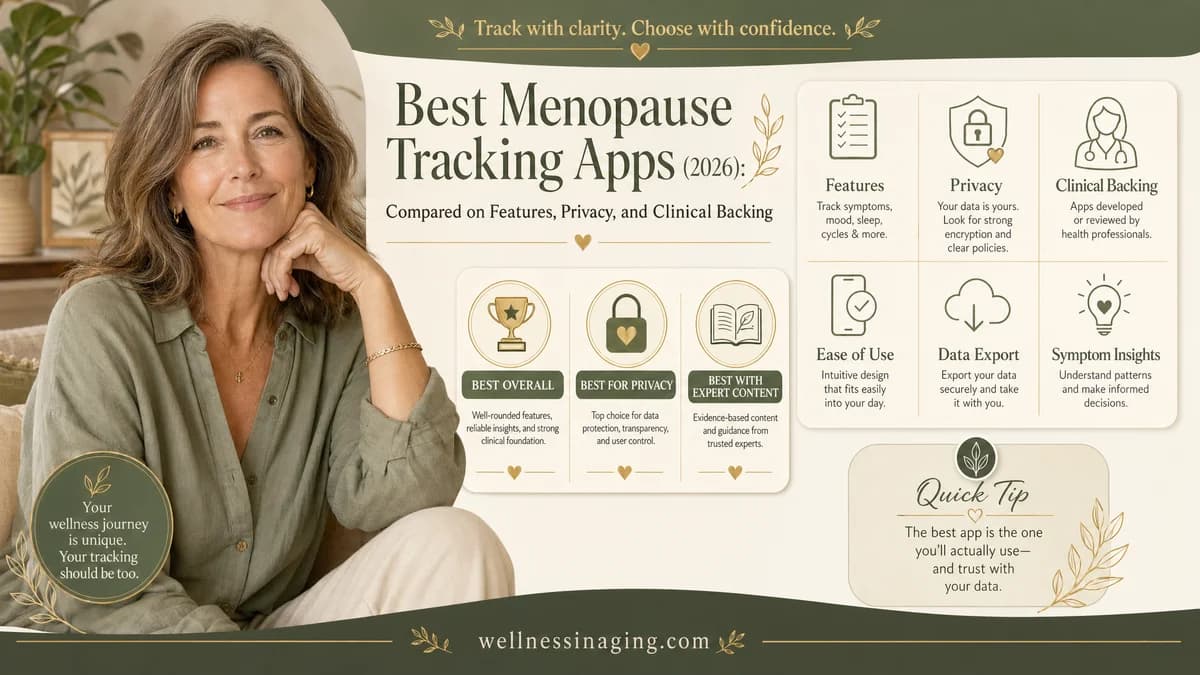
Free Download: Menopause Starter Guide — Evidence-based strategies for managing symptoms, a supplement reference, and a symptom tracker to bring to your doctor. No email required.
Download the Menopause Starter Guide →
Most menopause apps are not menopause apps. They are supplement storefronts with a symptom tracker bolted on, or period-tracking tools hastily rebranded when the demographic shifted. Of the dozens available, fewer than five have been evaluated in peer-reviewed research for clinical utility.
Here is how to tell the difference — and which ones are worth your time.
Some genuinely excellent tools have emerged. Free, clinically validated, privacy-respecting apps built specifically for the complexity of menopause.
This review covers seven apps. It's honest about their biases (every app has one — knowing it helps you use it better), clear about privacy, and direct about which ones are worth your time and money.
One thing you should know before starting: most women don't need an app. A plain notebook works. What apps genuinely add is structured tracking over time — making it easier to identify patterns, show your doctor meaningful data, and notice improvement or deterioration in specific symptoms. If that sounds useful to you, read on.
What to Look for in a Menopause App
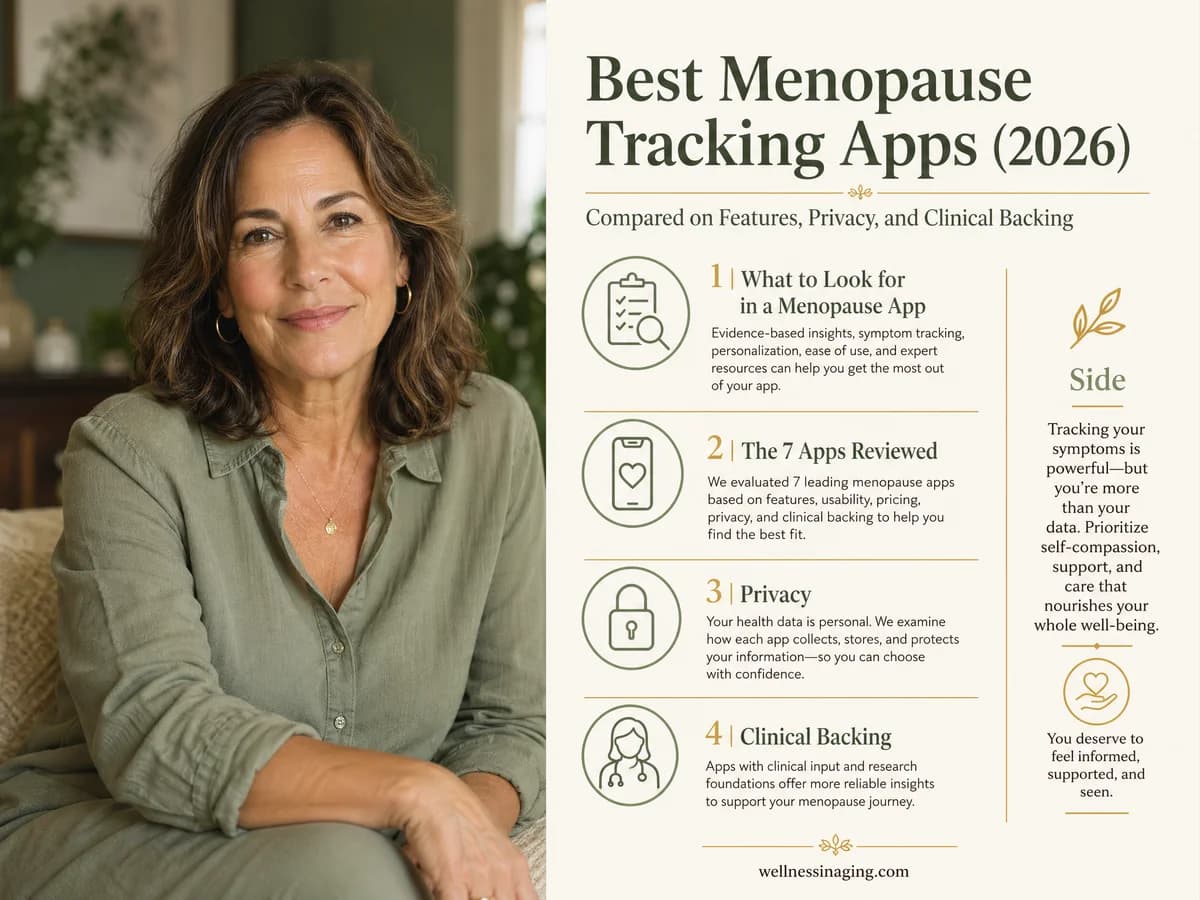
Before the reviews, a quick framework for evaluating any menopause app:
Clinical validation: Was this app developed with input from menopause specialists? Does the symptom framework reflect current menopause science, or is it based on general "women's health" assumptions?
Privacy policy: Health data about menopause symptoms, hormone levels, and sexual function is deeply personal — and under current US law, most health apps are NOT covered by HIPAA unless they connect directly to a healthcare provider. The FTC took enforcement action against period tracker apps in 2023 for sharing location and health data with third parties. Before logging anything sensitive, read the privacy policy.
Provider bias: Many menopause apps are built by companies with a commercial position on treatment. HRT-focused apps will frame everything toward initiating hormone therapy. Supplement-selling apps will frame everything toward their product stack. Neither is wrong — but you should know which direction each app leans.
Symptom breadth: Does it track the symptoms that actually bother you? Some apps focus narrowly on VMS (hot flashes, night sweats); others cover mood, cognition, joint pain, libido, sleep, skin, and more.
Actionability: Does the tracking actually lead to useful insights, or are you just accumulating data with no direction?
The 7 Apps Reviewed
1. MenoPro — Best Overall (Free)
Platform: iOS and Android | Cost: Free | Developer: The Menopause Society (NAMS)
MenoPro is the app built by The Menopause Society — the preeminent North American professional organization for menopause specialists. It was developed with clinician input and reflects current evidence-based guidelines. It's free, has no subscription upsell, and doesn't sell advertising.
What it does:
- Symptom tracker covering all major menopause domains (VMS, mood, sleep, cognition, libido, vaginal symptoms, urinary symptoms)
- "Am I in Menopause?" assessment tool
- Treatment decision support — presents options (HRT and non-hormonal) without obvious bias toward either
- Clinician-shareable symptom summaries (PDF export)
- Educational content sourced directly from NAMS guidelines
Privacy: Strong. No data sharing with third parties for advertising. NAMS is a nonprofit medical organization with no commercial supplement or pharmaceutical relationships.
Bias disclosure: Neutral. Presents both hormonal and non-hormonal options with evidence context.
Best for: Women who want a credible, no-cost symptom tracker to bring to medical appointments. The clinician summary export is genuinely useful — many women struggle to describe symptoms accurately in a 15-minute appointment, and having structured data helps.
Limitations: Interface is utilitarian rather than polished. The educational content, while accurate, is less interactive than premium apps.
Start here. It's free, it's credible, and it will serve most women well.
2. Balance — Best for HRT-Focused Management
Platform: iOS and Android | Cost: Free basic / £29.99/year (~$38) premium | Developer: Newson Health (Dr. Louise Newson)
Balance was developed by Dr. Louise Newson, a UK-based GP and menopause specialist who is one of the most prominent advocates for expanded access to HRT. The app has over 2 million downloads and a substantial community.
What it does:
- Extensive symptom tracker (over 40 symptoms)
- Menopause assessment and perimenopause identification
- HRT management tools — track your HRT type, dose, and changes over time, log side effects
- Large library of educational content
- Active community forum
- Monthly symptom report (shareable with doctors)
Privacy: Privacy policy is reasonably transparent; data is used for service improvement. UK-based, so subject to GDPR. Review the current policy before logging sensitive information.
Bias disclosure: Strongly pro-HRT. Dr. Newson is a vocal advocate for HRT access, and the app reflects this position. She has a clinical rationale — but if you're undecided about HRT, be aware that Balance will consistently frame information in that direction.
Best for: Women who have started or are seriously considering HRT and want to track their response, titrate symptoms against dosing, and engage with a like-minded community.
Limitations: Less useful if you're pursuing primarily non-hormonal approaches. Community can amplify pro-HRT perspective without always representing the full treatment spectrum.
Cost: The premium subscription adds deeper insights and community features. Free version is functional.
3. Clue — Best for Perimenopause Cycle Tracking
Platform: iOS and Android | Cost: Free basic / $19.99/year premium | Developer: BioWink GmbH (Germany)
Clue is one of the most widely used cycle tracking apps in the world, and it has built menopause-specific features into its perimenopause mode. Its strengths are in cycle data over time — tracking irregular periods, spotting changes in cycle length and flow, and correlating hormonal fluctuations with symptoms.
What it does:
- Cycle tracking designed for perimenopause (handles irregular, missed, or unpredictable periods)
- Symptom logging (mood, energy, sleep, pain, sex drive)
- Pattern analysis across cycles
- Perimenopause educational content
Privacy: Among the strongest of any app in this category. Clue is a German company (GDPR jurisdiction), does not sell user data, and has a published privacy policy with plain-language explanations. It explicitly does not share data with insurance companies or employers.
Bias disclosure: Neutral. Clue is not affiliated with any treatment approach, supplement brand, or pharmaceutical company.
Best for: Women in perimenopause who still have periods (even irregular ones) and want to track how cycle changes correlate with symptom patterns. The longitudinal cycle data is valuable for conversations with a gynecologist about where you are in the transition.
Limitations: Less useful once periods have stopped entirely. Symptom tracking is less comprehensive than dedicated menopause apps.
4. Stella — Best CBT-Based Program
Platform: iOS and Android | Cost: $99–240/year depending on plan | Developer: Stella (UK-based digital health company)**
Stella is different from the others on this list. It's less a tracker and more a structured program — drawing on cognitive behavioral therapy (CBT) and other evidence-based psychological approaches to reduce the distress caused by menopause symptoms.
CBT for menopause is not a fringe approach. The Hunter & Liao CBT protocol for menopause has clinical trial evidence demonstrating reduced hot flash bother (not frequency, but how much the hot flashes disrupt life) and improved mood and quality of life. Stella has digitized and adapted this approach.
What it does:
- 8–12 week structured CBT program adapted for menopause
- Paced breathing exercises (evidence-based for hot flash intensity)
- Mindfulness and cognitive restructuring modules
- Sleep improvement program
- Symptom tracking integrated with program progress
Privacy: GDPR-compliant (UK-based). Reasonable privacy protections; review current policy for specifics.
Bias disclosure: Pro-self-management and behavioral approaches. Less focus on medical/hormonal treatment.
Best for: Women who want to address the psychological and behavioral dimensions of menopause — particularly those with high hot flash distress, anxiety, or sleep disruption who prefer non-pharmaceutical approaches. Also excellent as a complement to HRT for managing residual symptoms.
Limitations: The price point ($99–240/year) is steep. It requires active participation — this is a program, not a passive tracker.
The most evidence-informed behavioral program in this space, but you need to commit to it to see results.
5. Midi Health — Best for Telehealth Access
Platform: iOS and web | Cost: Free app; clinical services billed separately (accepts many insurance plans) | Developer: Midi Health (US-based)
Midi Health is telehealth, not primarily a tracking app. It connects users with menopause-specialist clinicians (NPs and MDs with menopause training) who can prescribe HRT and other treatments. The app component enables symptom tracking, messaging with your care team, and prescription management.
What it does:
- Connects you to a menopause-specialist provider (50-state availability)
- Prescribes HRT, hormonal contraception (for perimenopause), and non-hormonal medications
- Ongoing care management via app
- Symptom tracking linked to your clinical record
Privacy: Subject to HIPAA (it's a healthcare provider). Strongest privacy protection of any app on this list.
Bias disclosure: Medical/prescribing orientation. Midi providers are trained in HRT and will discuss it as an option if appropriate for you.
Best for: Women who haven't been able to access a menopause-informed provider, who want HRT but face barriers, or who want ongoing specialist care without driving to an office.
Not for: Women who specifically want non-hormonal or self-directed management without clinical involvement.
Note on cost: The telehealth visit itself typically runs $50–175 depending on insurance. Many major insurance plans cover Midi visits. Prescriptions are handled through your regular pharmacy.
6. Natural Cycles — Best for Hormone-Free Cycle Tracking
Platform: iOS and Android | Cost: $99.99/year (thermometer included in starter kit) | Developer: Natural Cycles Nordic AB (Sweden)**
Natural Cycles is primarily a fertility awareness app (FDA-cleared as a contraceptive), but it has functionality relevant to perimenopause — specifically, basal body temperature (BBT) tracking as a way to correlate hormonal fluctuations with symptoms and cycle irregularity.
What it does:
- Daily BBT logging (requires taking temperature before getting out of bed each morning)
- Cycle prediction (handles perimenopausal irregularity less smoothly than Clue)
- Symptom logging
- Algorithm-based cycle analysis
Privacy: Strong; Swedish company under GDPR. Does not sell health data.
Bias disclosure: Neutral on treatment. Designed for women who prefer hormone-free approaches and body literacy.
Best for: Women who want a deeper understanding of their hormonal patterns during perimenopause through BBT data, particularly those who value natural family planning methods or prefer minimal-intervention approaches.
Limitations: The daily BBT requirement is a commitment. Perimenopausal cycles are irregular enough that the algorithm struggles. More relevant during early-to-mid perimenopause than later stages.
If you prefer structured symptom tracking but want to skip the app entirely, download our free Menopause Starter Guide — covers the same domains as the apps reviewed above.
7. Peppy — Workplace Benefit (Not Direct-to-Consumer)
Peppy is worth mentioning for completeness: it's a B2B menopause support platform delivered as an employee benefit through employers. If your company offers Peppy, it provides access to menopause coaches, 1:1 messaging with specialists, and educational content. Individual consumers cannot subscribe directly.
If your employer offers this: use it. If they don't: this review isn't relevant to you.
Side-by-Side Comparison
| App | Cost | Clinical Backing | Privacy | Bias | Best For |
|---|---|---|---|---|---|
| MenoPro | Free | NAMS (excellent) | Strong | Neutral | Everyone — start here |
| Balance | Free / $38/yr | Dr. Newson (good) | Good | Pro-HRT | HRT tracking & community |
| Clue | Free / $20/yr | Strong (GDPR, no data sharing) | Excellent | Neutral | Perimenopause cycle tracking |
| Stella | $99–240/yr | CBT evidence-based | Good | Pro-behavioral | High distress, behavioral management |
| Midi Health | Free app + clinical fees | MD/NP specialists | HIPAA (strongest) | Pro-medical | Telehealth access, prescriptions |
| Natural Cycles | $100/yr | FDA-cleared algorithm | Excellent | Neutral/natural | BBT tracking, body literacy |
| Peppy | Employer-provided | Good | Good | Neutral | Employees with access |
Privacy: What to Know Before You Log Anything
The FTC's 2023 actions against period tracker apps served as a warning: health apps that are not HIPAA-covered healthcare providers can share your data with third parties for advertising, analytics, or data brokerage — and most are not HIPAA-covered.
Practical steps:
- Read the data sharing section of the privacy policy before logging menstrual or symptom data
- Look specifically for language about third-party advertising partners, data brokers, and "de-identified" data sharing (which can often be re-identified)
- If a free app has no clear revenue model, your data is the product
- Use a non-primary email address to sign up if you have concerns
- Of the apps reviewed here, Clue (GDPR/Germany) and Midi Health (HIPAA) have the strongest privacy protections
Is This Article Right for You?
This article is for you if:
- You want to track menopause symptoms to identify patterns or show your doctor meaningful data
- You're evaluating whether to use an app or just stick with a notebook
- You're concerned about privacy and want to know which apps share your health data
- You're looking for an app with clinical backing, not just a rebranded period tracker
- You want to understand each app's bias (pro-HRT, pro-supplement, neutral) before committing
This probably isn't what you're looking for if:
- You're looking for an app that will "cure" symptoms — apps are tracking tools, not treatments
- You've already found an app that works for you and don't need alternatives
- You have zero interest in tracking and prefer managing symptoms without structured data
What Doesn't Work: App Features That Sound Good but Don't Help
Not every menopause app delivers on its promises. After reviewing dozens of apps and reading user experiences across forums and studies, certain patterns emerge repeatedly — features that look impressive in marketing but fail to produce meaningful outcomes.
Apps that collect data without guiding action. Many apps are excellent at symptom logging but stop there. You dutifully record hot flashes, sleep quality, and mood for weeks — and the app gives you a graph. That's it. No pattern analysis, no suggestions, no connection to what might help. Data collection without interpretation is just busywork. Before committing to an app, ask: "What will this app actually do with my data?"
"AI-personalized" recommendations without clinical validation. Some apps advertise machine learning algorithms that generate personalized supplement or lifestyle recommendations. The problem: these algorithms are proprietary, unpublished, and have no peer-reviewed evidence demonstrating they improve outcomes. A 2023 systematic review in JMIR mHealth found that most AI-driven health apps lack clinical validation studies. Personalization sounds sophisticated, but personalized nonsense is still nonsense.
Gamification features that boost engagement, not outcomes. Streaks, badges, points, and leaderboards are designed to keep you opening the app — which benefits the app's engagement metrics and advertising value. There's no evidence that earning a "7-day streak" badge correlates with symptom improvement. If an app feels more like a game than a health tool, question whose interests it serves.
Free apps where the free tier is nearly useless. Some apps offer a free version that lets you track one or two symptoms, then paywall every feature that would actually help — pattern analysis, symptom reports, educational content, provider sharing. The free tier exists to capture your data and convert you to paid. If an app's free version doesn't provide standalone value, the company's priority is extraction, not service.
Apps that position themselves as alternatives to medical care. No app can diagnose perimenopause, prescribe HRT, evaluate your cardiovascular risk factors, or determine whether your symptoms indicate something other than menopause. Apps that imply they can replace a conversation with a qualified provider are potentially dangerous. The best apps — MenoPro, Clue, Balance — explicitly position themselves as tools to support clinical care, not substitute for it.
Be skeptical of any app that promises transformation through tracking alone. Tracking is useful when it leads somewhere: a better conversation with your doctor, a pattern you can act on, a treatment you can evaluate. Tracking for its own sake is just another task on your list.
References
-
The Menopause Society. "Position Statement on Management of Menopause." Menopause. 2022;29(9):1-14. https://www.menopause.org/publications/clinical-practice-guidelines
-
Lyzwinski LN, et al. "A systematic review of mobile health apps for menopause symptom management: What is available and what works?" mHealth. 2021;7:44. doi:10.21037/mhealth-20-136
-
Hunter MS, Liao KL. "Evaluation of a four-session cognitive-behavioural intervention for menopausal hot flushes." British Journal of Health Psychology. 2010;15(Pt 3):603-617. doi:10.1348/135910709X479528
-
Federal Trade Commission. "FTC Enforcement Action Against Health App Data Sharing." Press Release. 2023. https://www.ftc.gov/news-events/press-releases
-
Earle S, et al. "mHealth apps for self-management of menopause symptoms: A systematic review and quality assessment." Journal of Medical Internet Research. 2023;25:e44209. doi:10.2196/44209
-
Bull JR, et al. "Real-world menstrual cycle characteristics of more than 600,000 menstrual cycles." npj Digital Medicine. 2019;2:83. doi:10.1038/s41746-019-0152-7
-
Jacobson AE, et al. "Mobile health applications for menopause: A content analysis and quality assessment." Menopause. 2022;29(3):327-335. doi:10.1097/GME.0000000000001912
The Recommendation
Start with MenoPro — it's free, it's built by the leading menopause professional organization in North America, and it exports a clinician-ready summary. For most women, it's all you need.
Add Balance if you're on HRT or actively pursuing it and want a community of women in the same boat.
Add Clue if you're still having periods (even erratic ones) and want longitudinal cycle data.
Consider Stella if behavioral approaches are a priority and you're willing to invest in a structured program. Learn more about Stella →
Use Midi Health if you haven't been able to access a knowledgeable provider — this is the most direct path to evidence-based clinical care from a specialist. Check if Midi accepts your insurance →
No app is a substitute for a knowledgeable clinician, but the right app can make that clinical conversation significantly more productive.
Ready to Start Tracking?
Download our free Menopause Starter Guide — no app required, no data collection, just a simple, effective way to track symptoms over 4 weeks before your next doctor appointment.
Prefer digital tracking? Download MenoPro (free on iOS and Android) — the most clinically credible option with no hidden costs or data sharing.
Need clinical care now? Midi Health connects you with menopause-specialist providers in all 50 states. Many insurance plans accepted.
This content is for informational purposes only and does not constitute medical advice. App features, pricing, and availability may change. Verify current details directly with each app before subscribing. Individual results may vary.
Related Reading
- HRT vs Natural Remedies — the treatment decision context that app tracking can support
- Menopause Brain Fog — cognitive symptom tracking is where apps add the most value
- Night Sweats During Menopause — symptom tracking baseline before trying interventions
- Best Menopause Supplements 2026 — if you're managing symptoms without prescription treatment
Free Download
The Menopause Supplement Evidence Guide
Which supplements have real research behind them. 12 pages, free.
Frequently Asked Questions
Related Articles
Probiotics and Menopause: The Gut-Hormone Connection (What the Science Says)
Your gut bacteria directly regulate estrogen metabolism through the estrobolome. Here's what probiotics can and can't do for menopause — with strain-specific evidence for bone health, mood, and vaginal health.
Read article →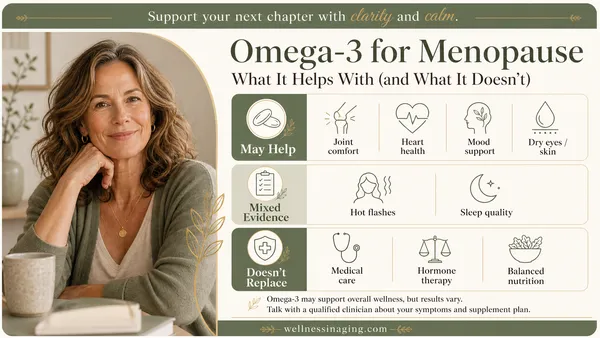
Omega-3 for Menopause: What It Helps With (and What It Doesn't)
Omega-3s have strong evidence for mood, joint pain, and heart health during menopause — but NOT for hot flashes. Here's the RCT data, the correct EPA vs DHA dose by symptom, and how to avoid rancid fish oil.
Read article →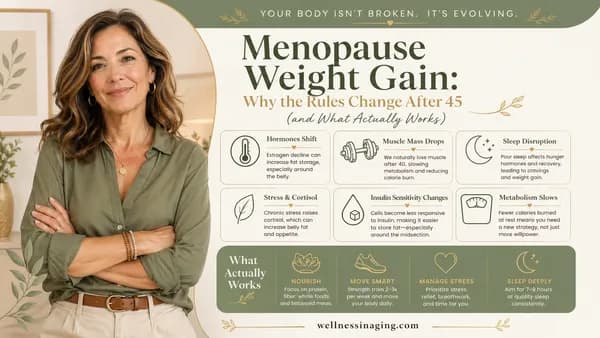
Menopause Weight Gain: Why the Rules Change After 45 (and What Actually Works)
Why menopause causes belly fat even when weight stays stable — the hormonal mechanism behind visceral fat redistribution and evidence-based strategies that work differently after 45.
Read article →