

Your doctor tells you omega-3s are good for your heart. Your friend swears fish oil fixed her menopause mood swings. The bottle at the pharmacy claims it supports "overall wellness." But when you search for specifics — will it actually help my hot flashes? my brain fog? my aching joints? — you find vague promises instead of answers.
Here's what most omega-3 articles won't tell you directly: omega-3 fatty acids have solid evidence for several menopause concerns, but they will not help with the symptom most women want addressed first — hot flashes. Multiple randomized controlled trials have tested this specifically, and the results are clear. Yet somehow this gets buried under generic "may support menopause" language.
This article gives you the evidence breakdown by symptom, with specific study citations, so you can decide whether omega-3s belong in your protocol. Below: what EPA and DHA actually do differently in your body, the exact doses used in successful clinical trials, how to avoid the 20-30% of fish oil products that are already rancid on the shelf, and which menopause symptoms respond to omega-3 — and which absolutely do not.
EPA vs. DHA: Why the Distinction Matters for Menopause
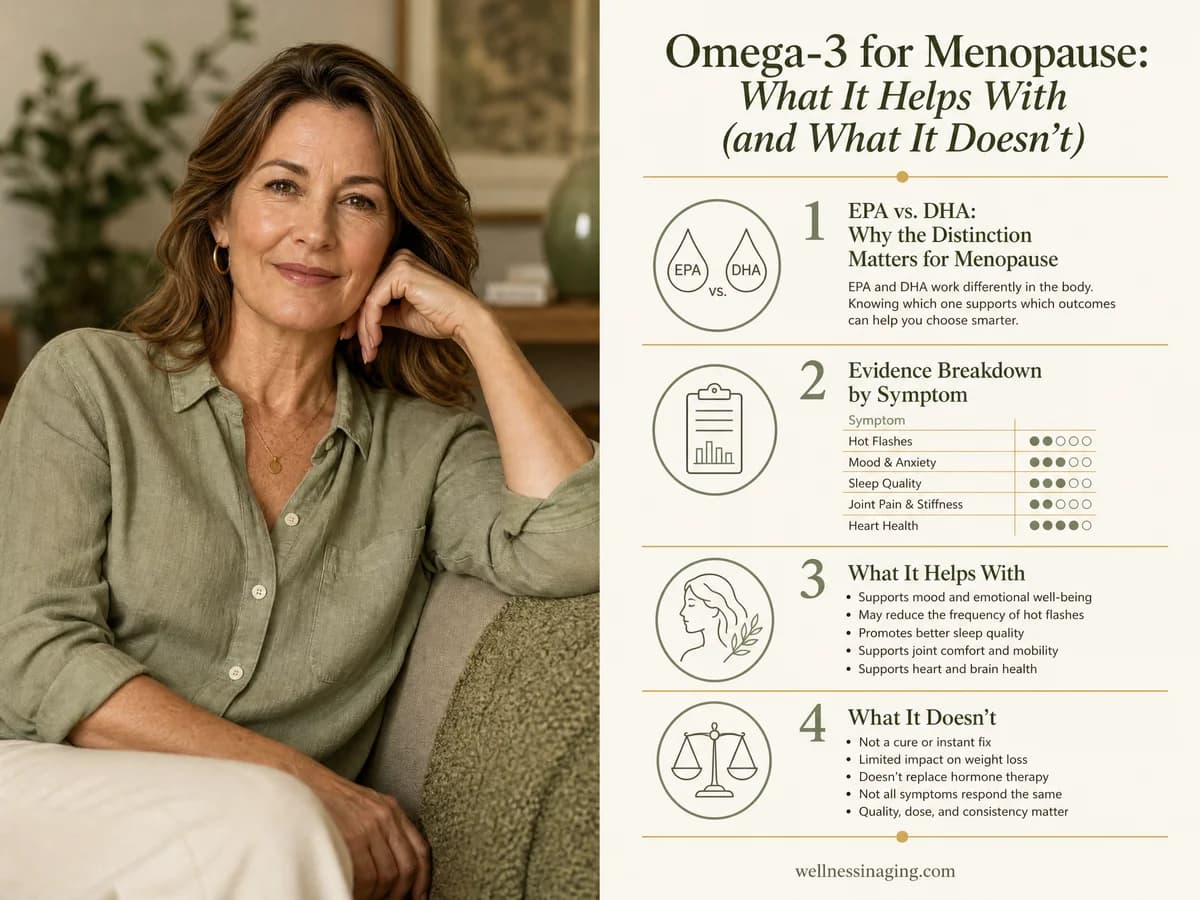
Most omega-3 advice treats "fish oil" as a single thing. This is like treating "carbohydrates" as one thing — technically accurate, practically useless. The two primary omega-3 fatty acids in fish oil, EPA and DHA, do different jobs in your body and address different menopause concerns.
EPA (Eicosapentaenoic Acid) is your anti-inflammatory and mood regulator. When your body processes EPA, it creates signaling molecules called resolvins and protectins that actively reduce inflammation. EPA competes with omega-6 fatty acids (abundant in modern diets) for incorporation into your cell membranes. When EPA wins that competition, your cells produce fewer inflammatory compounds and your mood chemistry stabilizes.
For menopause specifically, EPA is the active component for:
- Depression and mood changes — EPA is more effective than DHA for mood disorders (Sublette et al., 2011 meta-analysis)
- Joint pain and inflammation — 50-60% of menopausal women experience joint pain from estrogen-related inflammation increases
- Cardiovascular protection — EPA reduces triglycerides and modestly lowers cardiovascular event risk
DHA (Docosahexaenoic Acid) is your brain and eye structure fatty acid. DHA makes up about 40% of the fatty acids in your brain tissue. It maintains neuronal membrane fluidity — essentially, how well your brain cells can communicate with each other. During menopause, estrogen withdrawal reduces DHA synthesis and retention in the brain, which may contribute to cognitive symptoms.
For menopause specifically, DHA is the active component for:
- Cognitive function and brain fog — DHA supports memory and executive function
- Eye health — DHA is a structural component of your retina and tear film
- Neuroprotection — DHA supports brain structure maintenance as you age
The practical takeaway: If mood and inflammation are your primary concerns, prioritize EPA-rich fish oil (look for 2:1 or 3:1 EPA:DHA ratio). If brain fog and cognition are your primary concerns, choose balanced or DHA-rich formulations. For general menopause support, a balanced EPA+DHA combination covers multiple bases.
What about ALA from flaxseed? Alpha-linolenic acid (ALA) from plant sources like flaxseed, chia, and walnuts is an omega-3, but your body converts less than 1% of it to DHA and only 8-12% to EPA. These conversion rates drop further after menopause as estrogen declines. Plant-based ALA is not a substitute for marine EPA and DHA — if you're vegan, use algae oil (which provides direct EPA/DHA) rather than relying on flaxseed conversion.
Evidence Breakdown by Symptom
Not all menopause symptoms respond equally to omega-3 supplementation. Here's what the clinical trials actually found, organized by evidence strength.
Mood and Depression — Evidence: STRONG
This is omega-3's strongest application during menopause. Multiple randomized controlled trials specifically tested EPA-rich fish oil in perimenopausal and postmenopausal women with mood symptoms, and the results are consistently positive.
Freeman et al. (2011) enrolled 70 perimenopausal women with major depressive disorder. Those receiving 1.2g EPA + 0.6g DHA daily for 8 weeks showed significant reduction in depression scores (measured by Hamilton Depression Rating Scale) compared to placebo. Effect size was moderate to large (d=0.6).
Lucas et al. (2009) tested 1.05g EPA + 0.15g DHA daily in 120 perimenopausal and early postmenopausal women aged 40-55. After 8 weeks, the omega-3 group showed significant improvement in psychological distress and depressive symptoms on the Center for Epidemiologic Studies Depression Scale.
The Sublette meta-analysis (2011) pooled 15 RCTs on omega-3 for depression (not menopause-specific, but applicable) and found that EPA doses of 1g or more daily significantly reduce depressive symptoms. EPA appears more effective than DHA for mood — choose EPA-dominant formulations.
Practical application:
- Dose for depression: 1-2g EPA daily (DHA can be lower)
- Expected timeline: 4-8 weeks for noticeable mood improvement
- Best formulation: EPA-rich fish oil with 2:1 or 3:1 EPA:DHA ratio
Cardiovascular Health — Evidence: STRONG
After menopause, cardiovascular disease risk rises sharply. Estrogen had been protecting your blood vessels, keeping HDL high and LDL low. That protection disappears. By age 65, women's CVD risk equals men's. Omega-3s partially compensate for this lost protection.
The REDUCE-IT trial (2019) is the strongest evidence. In 8,179 adults with elevated triglycerides and existing CVD or diabetes, 4g daily of pure EPA (prescription icosapent ethyl) reduced major cardiovascular events — heart attacks, strokes, cardiovascular death — by 25% over 4.9 years. This is a prescription-strength dose, but it demonstrates EPA's cardiovascular potential.
The VITAL trial (2019) tested a more typical supplement dose (1g omega-3 daily) in 25,871 adults, about half women. The primary endpoint (major CV events) showed no significant overall reduction. However, subgroup analysis found a 28% reduction in heart attacks among African Americans and a 20% reduction among people eating less than 1.5 fish servings per week. Omega-3s help most if you're not already getting them from diet.
For triglycerides specifically: Omega-3s reliably reduce triglyceride levels by 15-30% at doses of 2-4g daily. This effect is consistent and well-documented across dozens of trials.
Practical application:
- Dose for heart health: 1-2g EPA+DHA daily for prevention; 2-4g daily for elevated triglycerides (discuss with doctor)
- Expected timeline: Triglycerides improve in 4-6 weeks; cardiovascular event reduction requires long-term use
- Note: Omega-3s do not replace statins but can complement them
Joint Pain and Inflammation — Evidence: STRONG
Joint pain affects 50-60% of menopausal women. Estrogen loss increases systemic inflammation, which directly contributes to joint stiffness, achiness, and arthralgia. EPA converts to anti-inflammatory compounds (resolvins, protectins, maresins) that reduce pro-inflammatory cytokines like IL-6, TNF-alpha, and IL-1beta.
Goldberg and Katz (2007) conducted a meta-analysis of 17 RCTs testing omega-3 for inflammatory joint pain (primarily rheumatoid arthritis). Doses of 2.7-9.6g daily over 3-4 months reduced joint pain intensity, morning stiffness duration, and NSAID use.
Gioxari et al. (2018) meta-analyzed omega-3 for rheumatoid arthritis and found that 2-3g EPA+DHA daily for 12 weeks reduced joint pain (measured by visual analog scale), number of tender joints, and morning stiffness.
Menopause-specific evidence: No large RCTs have tested omega-3 specifically for menopause-related joint pain. However, the mechanism is the same — inflammation-driven pain responds to anti-inflammatory intervention. Pot et al. (2010) confirmed that omega-3 supplementation reduces inflammatory markers (CRP, IL-6) in postmenopausal women specifically.
Practical application:
- Dose for joint pain: 2-3g EPA+DHA daily (higher than the mood dose)
- Expected timeline: 8-12 weeks for pain reduction — this is not immediate relief like ibuprofen
- Split dosing: Take 1-1.5g with two meals for better absorption
Cognitive Function and Brain Fog — Evidence: MODERATE
Brain fog during menopause — that frustrating sensation of mental sluggishness, word-finding difficulty, and scattered thinking — may partially respond to DHA supplementation. DHA is structural: it makes up 40% of brain fatty acids and maintains the fluidity of neuronal membranes. When DHA levels drop, brain cell communication becomes less efficient.
Yurko-Mauro et al. (2010) tested 900mg DHA daily in 485 adults aged 55+ with age-related cognitive decline (not dementia). After 24 weeks, the DHA group showed improved episodic memory (paired associate learning test) and learning function. Executive function and processing speed did not improve.
Witte et al. (2014) gave 2.2g omega-3 daily to 65 healthy older adults (mean age 63) for 26 weeks. Results included improved executive function (cognitive flexibility), increased gray matter volume in the hippocampus on MRI, and enhanced white matter integrity.
Menopause-specific caveat: No large RCTs have tested omega-3 specifically for perimenopause brain fog. The evidence comes from studies in "aging adults" generally — which includes many postmenopausal women but wasn't designed to isolate menopause-related cognitive changes.
Practical application:
- Dose for cognition: 500-1000mg DHA daily
- Expected timeline: 12-26 weeks for measurable improvement — this is a long-term intervention
- Formulation: DHA-rich or balanced EPA/DHA formulation
Hot Flashes — Evidence: WEAK/NEGATIVE
Here's the uncomfortable truth most omega-3 articles avoid stating clearly: omega-3s do not reduce hot flash frequency or severity. Multiple randomized controlled trials have tested this directly, and the results are consistently negative.
Lucas et al. (2009) — the same study that found omega-3 helped mood — specifically measured hot flash outcomes. Result: no significant reduction in hot flash frequency or severity with 1.05g EPA + 0.15g DHA daily.
Freeman et al. (2011) — the same study that found omega-3 helped depression — also tracked vasomotor symptoms. Result: no significant reduction in hot flashes with 1.2g EPA + 0.6g DHA daily.
Cohen et al. (2014) followed 483 postmenopausal women for 2 years with 1g EPA+DHA daily. Result: no effect on vasomotor symptoms.
Why don't omega-3s work for hot flashes? Hot flashes are mediated by KNDy neurons (kisspeptin/neurokinin B/dynorphin) in the hypothalamus, which are directly modulated by estrogen. Omega-3s are anti-inflammatory, but they do not replicate estrogenic effects on thermoregulation. The same holds for evening primrose oil — another fatty acid supplement that failed two RCTs for hot flashes — reinforcing that no fatty acid, omega-3 or omega-6, addresses thermoregulation through this pathway.
What works instead:
- HRT: 75-90% reduction in hot flashes (evidence: STRONG)
- Black cohosh: 20-30% reduction (evidence: MODERATE) — read our black cohosh article
- Soy isoflavones: 20-50% reduction (evidence: MODERATE-STRONG)
- Paced breathing: 40-50% reduction in intensity (evidence: STRONG)
If hot flashes are your primary concern, omega-3s are not your answer. Redirect your budget and expectations to interventions with positive evidence.
Vaginal Dryness — Evidence: INSUFFICIENT
No randomized controlled trials have tested omega-3 for vaginal dryness. The theoretical mechanism — omega-3s support mucous membrane health — has not been validated clinically. Anecdotal reports exist but carry no scientific weight.
Better options: Vaginal estrogen (prescription), vaginal moisturizers (Replens), lubricants, or hyaluronic acid-based products.
Bone Density — Evidence: WEAK/INSUFFICIENT
Animal studies show potential; human studies show inconsistent results. Omega-3s may reduce inflammatory cytokines that activate bone-resorbing osteoclasts, but this theoretical benefit hasn't translated to clinical bone protection.
Orchard et al. (2012) found an association between higher omega-3 intake and 7% lower fracture risk in the Women's Health Initiative cohort (137,486 postmenopausal women). However, association does not prove causation.
Fonolla-Joya et al. (2016) tested omega-3 alone vs. omega-3 + calcium + vitamin D in postmenopausal women. Omega-3 alone showed no effect on bone mineral density.
Practical implication: Do not rely on omega-3 for osteoporosis prevention. Calcium, vitamin D, strength training, and (if needed) bisphosphonates are evidence-based for bone health. Omega-3 might be a modest adjunct but is not sufficient alone.
Symptom-Specific Dosing Table
| Symptom | Recommended Dose | EPA:DHA Ratio | Timeline | Evidence |
|---|---|---|---|---|
| Depression/Mood | 1-2g EPA daily | 2:1 or 3:1 EPA:DHA | 4-8 weeks | STRONG |
| Cardiovascular | 1-2g EPA+DHA daily | Balanced | Ongoing | STRONG |
| Joint Pain | 2-3g EPA+DHA daily | EPA-rich | 8-12 weeks | STRONG |
| Cognitive/Brain Fog | 500-1000mg DHA daily | Balanced or DHA-rich | 12-26 weeks | MODERATE |
| Hot Flashes | NOT effective | — | — | WEAK (negative) |
| Bone Health | NOT sufficient alone | — | — | INSUFFICIENT |
| Vaginal Dryness | No evidence | — | — | INSUFFICIENT |
For general menopause support (mood + inflammation + heart health): 1.5-2g combined EPA+DHA daily, with EPA:DHA ratio around 2:1. Example: 1000mg EPA + 500mg DHA.
Upper safety limit: The FDA considers up to 5g daily of combined EPA+DHA generally safe. The European Food Safety Authority agrees. Most people should stay in the 1-3g daily range; higher doses (3-5g) are therapeutic and should be discussed with your doctor.
Quality Warning: The Rancidity Problem
This section addresses something most omega-3 articles skip entirely: a significant portion of fish oil products on store shelves are already rancid when you buy them. This matters because oxidized fish oil is not just ineffective — it may be actively harmful.
How common is rancidity?
- ConsumerLab (2023): 22% of fish oil products tested exceeded oxidation limits
- Labdoor (2022): 30% of fish oils showed detectable rancidity
- Many products exceed the GOED (Global Organization for EPA and DHA) voluntary oxidation standards
Why rancid fish oil is problematic:
- Pro-inflammatory rather than anti-inflammatory (defeating the entire purpose)
- Pro-oxidative (accelerates cellular damage rather than preventing it)
- Causes intensified fishy burps and digestive discomfort
- May increase, rather than decrease, cardiovascular risk markers
How to Assess Quality Before Buying
1. Look for IFOS Certification IFOS (International Fish Oil Standards) is the gold standard for third-party testing. They test for potency (actual EPA/DHA content), purity (heavy metals, PCBs, dioxins), oxidation (TOTOX value), and label accuracy. A 5-star IFOS rating is the highest quality mark.
You can search their database at ifosprogram.com to verify products.
Brands with consistent IFOS 5-star ratings: Nordic Naturals, Carlson, Wiley's Finest, Pharmax
2. Check the Form on the Label
- Triglyceride (TG) form: Natural form, better absorbed, more stable. Look for.
- Re-esterified triglyceride (rTG): Concentrated but converted back to natural form. Excellent choice.
- Ethyl ester (EE): Created during concentration, 20-30% lower absorption than triglyceride form, more prone to oxidation. Acceptable budget option but not ideal.
3. Verify Freshness
- Check expiration date — buy products with more than 1 year of shelf life remaining
- Buy from high-turnover retailers, not dusty pharmacy shelves
- Choose dark glass bottles or opaque containers (light accelerates oxidation)
How to Assess Quality After Buying
The smell test: Cut open a capsule. High-quality fish oil smells mildly oceanic — a faint, clean fish scent. It should NOT smell strongly fishy, paint-like, bitter, or sour. If it does, the oil is oxidized. Throw it away.
Storage matters:
- Refrigerate after opening (slows oxidation)
- Keep away from light and heat
- Use within 3 months of opening
- Buy smaller bottles (30-60 day supply) rather than bulk
TOTOX Value Explained
TOTOX (Total Oxidation) is the standard measure of fish oil freshness. It combines two measurements:
- Peroxide value (PV): measures primary oxidation
- Anisidine value (AV): measures secondary oxidation
- Formula: TOTOX = 2 × PV + AV
Quality threshold: TOTOX should be under 26 (lower is better). Premium products often have TOTOX under 10.
You can sometimes find TOTOX values on manufacturer websites or Certificates of Analysis. If a company won't share their TOTOX data, that's a red flag.
Forms Explained: Fish Oil vs. Krill Oil vs. Algae Oil
Fish Oil — Best Value, Most Evidence
Source: Small fatty fish (anchovies, sardines, mackerel, herring)
EPA+DHA content:
- Standard fish oil: ~300mg EPA + 200mg DHA per 1000mg capsule
- Concentrated fish oil: ~600-900mg EPA+DHA per 1000mg capsule
Pros: Most studied form, cost-effective ($0.05-0.15 per 100mg EPA+DHA), widely available, high EPA+DHA per serving
Cons: Fishy aftertaste/burps (solvable — freeze capsules or take with meals), sustainability concerns (choose MSC-certified), requires quality verification
Best for: Most people, especially those prioritizing value and evidence
Algae Oil — Best for Vegans
Source: Microalgae (Schizochytrium, Nannochloropsis)
EPA+DHA content: Typically DHA-dominant (250-400mg DHA, variable EPA)
Pros: Vegan/vegetarian-friendly, no fishy taste, sustainable (closed-system cultivation), no mercury risk, no fish allergen
Cons: More expensive ($0.12-0.20 per 100mg EPA+DHA), fewer clinical studies, historically DHA-heavy (though newer products include EPA)
Bioavailability: Equivalent to fish oil (Arterburn et al., 2008)
Best for: Vegans, vegetarians, people with fish allergies, severe fishy burp intolerance
Krill Oil — Premium Price, Marginal Benefit
Source: Antarctic krill (tiny crustaceans)
EPA+DHA content: Lower per serving (~120-180mg EPA+DHA per 500mg capsule) but in phospholipid-bound form
Claimed advantage: Phospholipid form is better absorbed than triglyceride form
Reality check: Schuchardt et al. (2011) found krill oil absorption is only 10-15% better than ethyl ester fish oil — and equal to triglyceride-form fish oil. The absorption advantage is overstated and doesn't justify the 3-4x price premium.
Cost: $0.25-0.40 per 100mg EPA+DHA (3-4x more expensive than fish oil for equivalent EPA+DHA)
Cons: Expensive, shellfish allergen, sustainability concerns (Antarctic ecosystem), less EPA+DHA per dollar
Best for: Only if budget is unlimited OR you cannot tolerate fish oil in any form
Bottom line: Fish oil (triglyceride form) offers the best combination of evidence, efficacy, and value. Algae oil is the clear choice for vegans. Krill oil is overpriced for what it delivers.
Drug Interactions and Safety Concerns
Blood Thinners (Anticoagulants and Antiplatelets)
Mechanism: Omega-3s have mild antiplatelet effects — they reduce platelet aggregation, which theoretically increases bleeding risk.
Clinical reality: Most studies show NO increased bleeding risk at typical supplement doses (under 3g daily), even in patients taking warfarin, aspirin, or clopidogrel. The theoretical concern has not materialized clinically.
Medications to discuss with your doctor:
- Warfarin (Coumadin)
- Heparin
- Aspirin (daily use)
- Clopidogrel (Plavix)
- Apixaban (Eliquis), rivaroxaban (Xarelto), dabigatran (Pradaxa)
- NSAIDs (ibuprofen, naproxen) — occasional use is fine
Practical guidance:
- Under 3g daily: Generally safe; inform your doctor but special monitoring usually unnecessary
- Over 3g daily: Discuss with doctor; watch for unusual bruising, nosebleeds, or blood in stool
- Pre-surgery: Some surgeons recommend stopping omega-3s 1-2 weeks before surgery; others don't. Ask your surgeon specifically.
Blood Pressure Medications
Mechanism: Omega-3s modestly lower blood pressure (3-5 mmHg reduction at 2-3g daily). This adds to the effect of BP medications.
Clinical significance: Usually beneficial — better blood pressure control. However, monitor for symptoms of low blood pressure (dizziness, lightheadedness).
Medications: ACE inhibitors, ARBs, beta-blockers, diuretics, calcium channel blockers
Practical guidance: Monitor BP if starting omega-3 at doses over 2g daily. You may need a medication dose reduction — discuss with your doctor.
Statins
Interaction: None. Omega-3s and statins work through different mechanisms and complement each other well.
Benefit: Omega-3s lower triglycerides; statins lower LDL cholesterol. Combined, they provide broader cardiovascular protection.
Prescription omega-3s (Vascepa, Lovaza) are FDA-approved for use WITH statins for high triglycerides.
Diabetes Medications
Concern: High-dose omega-3 (over 3g daily) may slightly increase blood glucose and HbA1c in some people with type 2 diabetes. The effect is small and inconsistent.
Practical guidance: If taking more than 3g daily and you have diabetes, monitor blood glucose. At 1-2g daily, no special monitoring needed.
The Bottom Line
Omega-3s have genuine value for menopause — but only for specific symptoms. The evidence is strong for mood and depression (1-2g EPA daily), cardiovascular protection (1-2g EPA+DHA daily), and joint pain (2-3g EPA+DHA daily). The evidence is moderate for cognitive support (500-1000mg DHA daily). The evidence is negative for hot flashes — don't waste your money or expectations there.
If you're starting omega-3s for menopause support, here's your action plan: Choose a triglyceride-form fish oil with IFOS 5-star certification. Start with 1.5-2g combined EPA+DHA daily (EPA-dominant if mood is your priority). Take with a meal containing fat for better absorption. Expect 6-8 weeks before evaluating results. If fish oil isn't working after 3 months, reassess whether it's the right intervention for your symptoms.
For hot flashes specifically, redirect to evidence-based options: our magnesium article addresses sleep and anxiety, our best menopause supplements roundup covers the full evidence hierarchy.
Download the Menopause Starter Guide →
References
-
Freeman EW, Sammel MD, Lin H, et al. "Omega-3 fatty acids for major depressive disorder associated with the menopausal transition." Menopause. 2011;18(3):279-284.
-
Lucas M, Asselin G, Mérette C, Poulin MJ, Bherer L. "Ethyl-eicosapentaenoic acid for the treatment of psychological distress and depressive symptoms in middle-aged women." American Journal of Clinical Nutrition. 2009;89(2):641-651.
-
Sublette ME, Ellis SP, Geant AL, Mann JJ. "Meta-analysis of the effects of eicosapentaenoic acid (EPA) in clinical trials in depression." Journal of Clinical Psychiatry. 2011;72(12):1577-1584.
-
Yurko-Mauro K, McCarthy D, Rom D, et al. "Beneficial effects of docosahexaenoic acid on cognition in age-related cognitive decline." Alzheimer's & Dementia. 2010;6(6):456-464.
-
Bhatt DL, Steg PG, Miller M, et al. (REDUCE-IT Investigators). "Cardiovascular risk reduction with icosapent ethyl for hypertriglyceridemia." New England Journal of Medicine. 2019;380(1):11-22.
-
Goldberg RJ, Katz J. "A meta-analysis of the analgesic effects of omega-3 polyunsaturated fatty acid supplementation for inflammatory joint pain." Pain. 2007;129(1-2):210-223.
-
Gioxari A, Kaliora AC, Marantidou F, Panagiotakos DP. "Intake of omega-3 polyunsaturated fatty acids in patients with rheumatoid arthritis: A systematic review and meta-analysis." Nutrition. 2018;45:114-124.
-
Witte AV, Kerti L, Herber AJ, et al. "Long-chain omega-3 fatty acids improve brain function and structure in older adults." Cerebral Cortex. 2014;24(11):3059-3068.
This content is for informational purposes only and does not constitute medical advice. Always consult with a qualified healthcare provider before starting any new supplement or treatment. Individual results may vary.
Free Download
The Menopause Supplement Evidence Guide
Which supplements have real research behind them. 12 pages, free.
Frequently Asked Questions
Related Articles

Probiotics and Menopause: The Gut-Hormone Connection (What the Science Says)
Your gut bacteria directly regulate estrogen metabolism through the estrobolome. Here's what probiotics can and can't do for menopause — with strain-specific evidence for bone health, mood, and vaginal health.
Read article →
Maca Root for Menopause: Does It Actually Work? (The Evidence)
Maca root is widely promoted for menopause. Here's what the RCTs actually show — what it helps with (libido, mood), what it doesn't (hot flashes), and the correct dose.
Read article →
Evening Primrose Oil for Menopause: The Honest Evidence Review
Two high-quality RCTs show evening primrose oil does NOT reduce hot flashes. Here's what the science says, why it's still widely recommended, and what actually works instead.
Read article →