
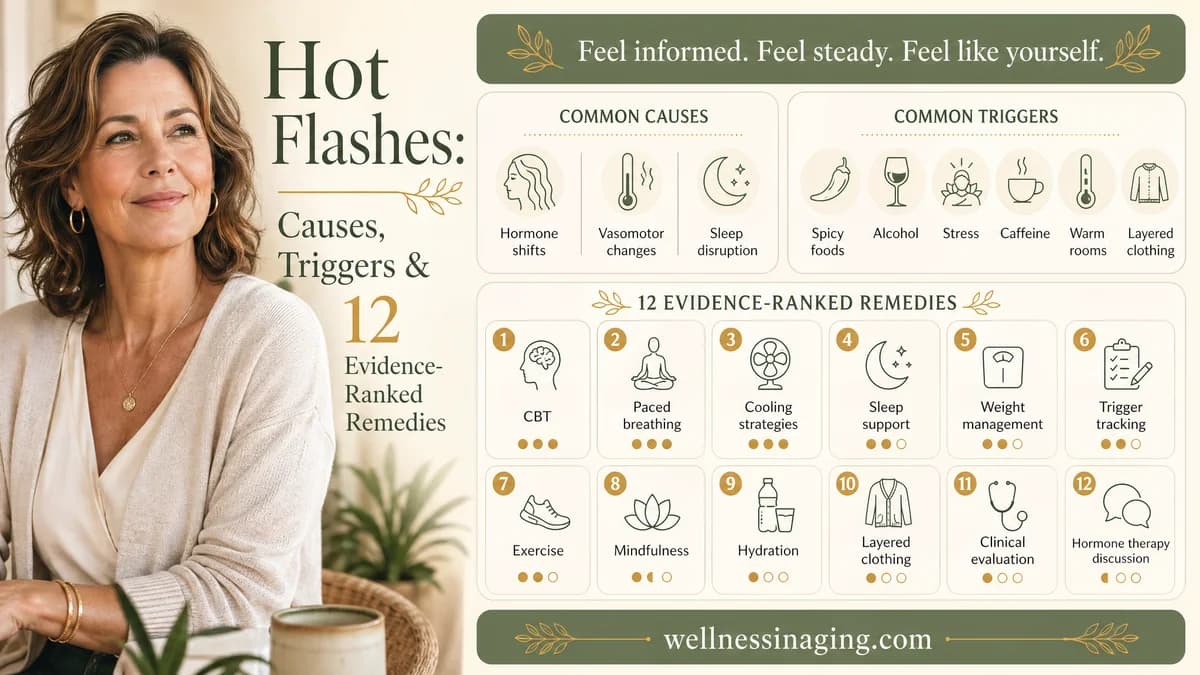
There is a cluster of neurons in your hypothalamus called KNDy neurons. When estrogen drops, they get loud — they fire so aggressively that your brain shrinks the temperature range it considers "comfortable" from about 0.4°C down to nearly zero. A change in core body temperature smaller than the warmth from a cup of tea is now enough to trip the alarm. That is a hot flash. Not a vague hormonal nuisance. A specific, traceable misfire in a tiny circuit most women have never heard of.
Roughly 75-80% of women going through menopause experience them, according to the North American Menopause Society. The median duration is 7.4 years past the final period — not the 6 to 12 months most women are told to expect. Below: the actual mechanism, the triggers worth tracking, and the 12 most-studied remedies ranked from strongest evidence to weakest. Specific dosages included.
What Actually Causes Hot Flashes During Menopause
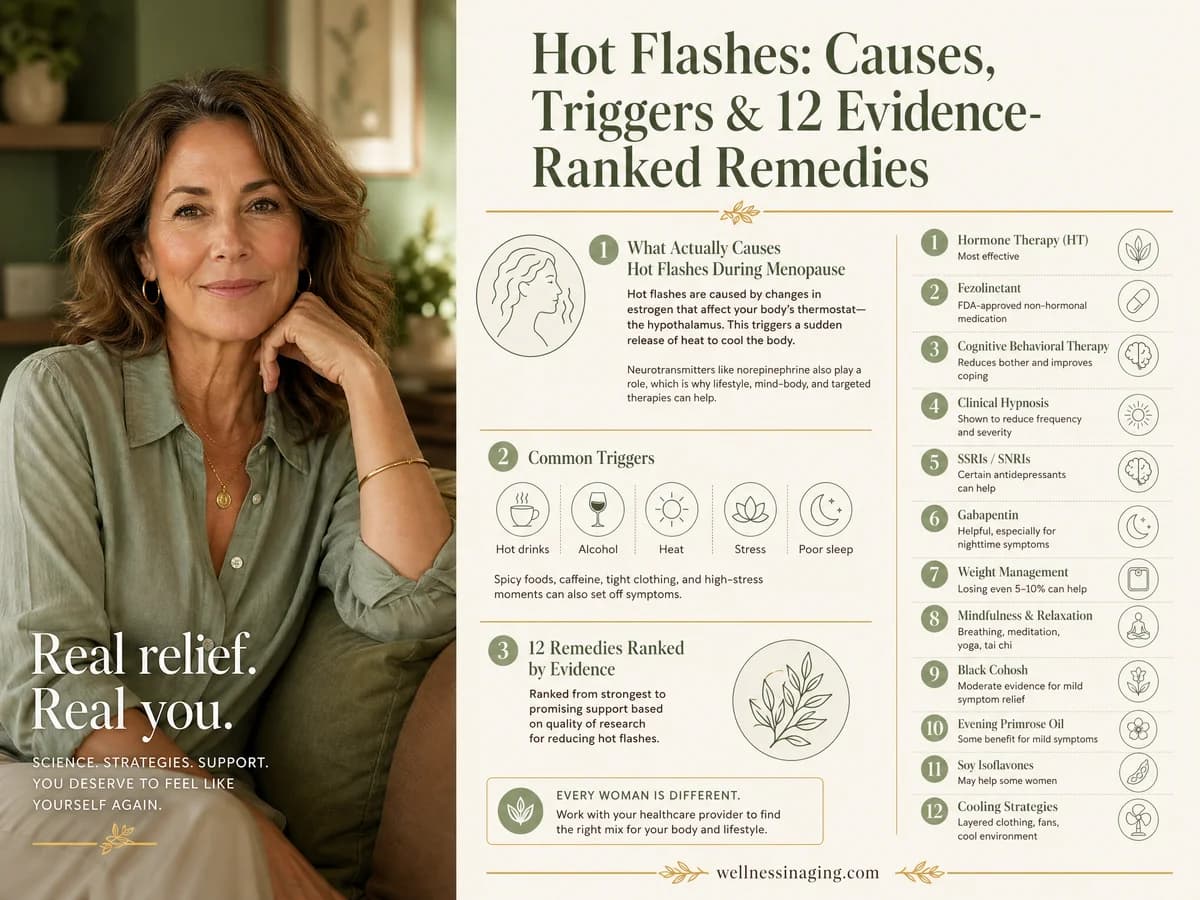
Estrogen does many things. One of them is keeping a small group of neurons in the hypothalamus — the KNDy network (kisspeptin, neurokinin B, dynorphin) — quiet and balanced. These neurons help regulate body temperature.
When estrogen falls during perimenopause and menopause, KNDy neurons enlarge and ramp up neurokinin B signaling. The downstream effect is a narrowed thermoneutral zone. The thermoneutral zone is the temperature window your body considers neutral — neither too hot nor too cold. In a woman without vasomotor symptoms, that zone spans roughly 0.4°C. In a woman with frequent hot flashes, it can collapse to nearly zero. This same hormonal shift drives many of the mood changes during menopause — the neural circuits are closely interconnected.
That is why a hot flash feels like it comes "out of nowhere." A trivial bump in core temperature — a sip of warm coffee, a moment of stress, a slightly heavier blanket — now exceeds the upper threshold. Your brain interprets this as overheating and triggers an emergency cooling response: skin vasodilation, sweating, and a sensation of intense heat that often starts in the chest and spreads upward. Skin temperature can rise 1-7°C locally in 1-5 minutes (Freedman, 2014).
The clinical implication is precise: hot flashes are not "hormone deficiency" in the abstract. They are a specific neural circuit responding inappropriately to small temperature shifts. This is why the newest treatment, fezolinetant, works at all — it blocks neurokinin B at its receptor and quiets the circuit directly, without touching estrogen.
Common Triggers — and What to Do About Each
Triggers do not cause hot flashes. The narrowed thermoneutral zone causes them. Triggers are simply the small inputs that push your body across the now-tiny threshold. Identifying yours is the cheapest intervention available.
| Trigger | Why It Sets Off a Flash | What to Do |
|---|---|---|
| Alcohol (especially red wine) | Vasodilates skin vessels, raises core temp | Cap at one drink; switch to white or sparkling water with bitters |
| Caffeine | Stimulates sympathetic nervous system, raises core temp | Move all caffeine to before 11am; cap at 200mg/day |
| Spicy food | Capsaicin activates heat-sensing receptors | Reduce capsaicin-heavy meals at dinner; flashes overnight often follow |
| Hot drinks | Direct thermal load | Drink coffee/tea lukewarm; iced versions in summer |
| Stress and acute anxiety | Sympathetic activation; cortisol surge | 4-7-8 breathing or paced respiration before stressful events |
| Warm rooms (>22°C / 72°F) | Reduces margin to upper threshold | Drop bedroom to 18-19°C (65-67°F) overnight |
| Tight or synthetic clothing | Traps heat against skin | Layered cotton, linen, merino, or moisture-wicking athletic fabric |
| Smoking | Damages thermoregulation; 60% higher vasomotor symptom severity (Whiteman, 2003) | Stop. Most modifiable single risk factor. |
| Sugar spikes | Drives a brief insulin/sympathetic response | Pair carbs with protein and fat; avoid refined sugar at night — metabolic shifts also contribute to menopause-related weight gain |
The most useful self-experiment is a 14-day flash log. Note the time of each flash, what you ate or drank in the 60 minutes before, your stress state, and the room temperature. Patterns emerge faster than you'd expect — usually two or three personal triggers account for the majority of episodes. Most women in online communities say the same: they spent months suffering before discovering their number-one trigger was a nightly glass of wine.
Free Download: Menopause Starter Guide — Evidence-based strategies for managing symptoms, a supplement reference, and a symptom tracker to bring to your doctor. No email required.
21 evidence-based strategies organized by strength of evidence — with specific dosages, timing, and what to try first based on your symptom pattern. Takes 5 minutes to set up your personal plan. Download the Menopause Starter Guide →
12 Remedies Ranked by Evidence
Treatments are listed strongest to weakest by clinical evidence for reducing hot flash frequency or severity. "Reduction" numbers are versus placebo in randomized controlled trials.
1. Fezolinetant (Veozah) — Strong Evidence: 59-63% reduction
FDA approved in 2023, fezolinetant is the first non-hormonal medication designed specifically for the KNDy mechanism. It blocks the neurokinin B receptor and effectively re-widens the thermoneutral zone. In Phase 3 trials (Depypere, 2021), the 30mg dose reduced hot flash frequency by ~59% and the 45mg dose by ~63%, versus ~26% in the placebo group, at 12 weeks. Onset is fast — many women notice a difference within days. Liver enzymes need monitoring. Most major US menopause societies now consider it a first-line non-hormonal option for moderate-to-severe vasomotor symptoms. It is a prescription-only drug; ask your provider whether you are a candidate.
2. Hormone Replacement Therapy (HRT) — Strong Evidence: 75-90% reduction
The most effective treatment by a wide margin. Per the NAMS 2022 Hormone Therapy Position Statement, HRT reduces hot flash frequency by 75-90%. For women under 60 or within 10 years of menopause without contraindications (history of breast cancer, blood clots, certain cardiovascular conditions), the benefit-risk profile is generally favorable. Forms vary — transdermal estrogen, oral estrogen, with or without progesterone depending on whether you have a uterus. This is a clinical decision, not a self-decision. For a side-by-side, see HRT vs natural remedies for menopause.
3. SSRIs and SNRIs — Strong Evidence: 40-60% reduction
Low-dose paroxetine (Brisdelle, 7.5mg) is FDA-approved specifically for hot flashes. Escitalopram at 10-20mg/day reduced hot flash frequency by 47% versus 33% placebo in a 2011 JAMA trial (Freeman, n=205). Venlafaxine is the most-studied SNRI for vasomotor symptoms. Useful for women who cannot or prefer not to take HRT — particularly breast cancer survivors. Onset is 2-4 weeks. Side effects include nausea, sleep changes, and reduced libido.
4. Gabapentin — Moderate Evidence: 45% reduction
A nerve-targeting medication, originally developed for seizures, that reduces hot flash severity by ~45% at 900mg/day in three divided doses (Guttuso, 2003, n=59). Most useful for women whose flashes cluster at night, since the dominant side effect — drowsiness — becomes a benefit rather than a problem when concentrated at bedtime. Less useful during the day.
5. Paced Respiration — Moderate Evidence: 44% reduction
The behavioral intervention with the strongest randomized trial evidence. Slow diaphragmatic breathing at 6-8 breaths per minute (roughly 4 seconds in, 6 seconds out), practiced for 15 minutes twice daily and at the onset of a flash, reduced flash frequency by 44% in Freedman and Woodward's 1992 study. Mechanism: it activates the parasympathetic nervous system and reduces the sympathetic tone that triggers vasodilation. Free, no side effects, and one of the few interventions you can deploy mid-flash to shorten an episode. The 2am version of a hot flash — when your heart is already racing — responds particularly well to this.
6. Cognitive Behavioral Therapy (CBT) — Moderate Evidence: quality-of-life benefit
CBT does not reliably reduce flash frequency, but it consistently reduces how disruptive flashes feel — sometimes called "hot flash interference." A short CBT protocol (4-6 weeks, often available in group format or via apps) helps women uncouple the physical sensation from the emotional distress that amplifies it. Especially valuable for women whose flashes are tolerable in number but psychologically overwhelming.
7. Black Cohosh (Cimicifuga racemosa) — Moderate Evidence: modest reduction
In Osmers' 2005 RCT (n=304, 12 weeks), standardized isopropanolic black cohosh extract (Remifemin, 40mg twice daily) reduced Kupperman Menopause Index scores significantly more than placebo, with hot flash frequency about 26% lower than placebo. A 2010 meta-analysis of 9 RCTs (Shams) confirmed a modest but real benefit. The honest caveat: results are substantially smaller than HRT, and many women — including the ones complaining loudly on r/Menopause — feel no effect. Allow 8-12 weeks before judging. Avoid if you have liver disease; rare hepatotoxicity has been reported.
8. Soy Isoflavones / Phytoestrogens — Limited Evidence: ~20% reduction (variable)
The 2007 Cochrane review (Lethaby, 25 trials, 2,348 women) found that high-dose soy isoflavones (≥54mg/day) reduce hot flash frequency by roughly 20% over placebo. The catch is real and often missed: the effect appears strongest in women who carry equol-producing gut bacteria, which is only 30-50% of Western populations. If soy isoflavones do nothing for you after 8 weeks, you are likely a non-equol producer and should move on. See foods to reduce hot flashes for dietary sources.
9. Magnesium Glycinate — Limited Evidence: indirect benefit
Direct evidence in menopausal women is thin — the most-cited trial used breast cancer patients on chemotherapy (Shanafelt, 2010). Where magnesium clearly helps is the wreckage hot flashes leave behind: disrupted sleep, anxiety, and night-time awakenings. Magnesium glycinate at 200-400mg before bed improves sleep quality and reduces nocturnal arousals in multiple trials. For night sweats specifically, this is often the difference between a 3am flash that ends the night and one you sleep through. Full breakdown in magnesium for menopause.
10. Cooling Products — Symptomatic Relief
Cooling pillows, cooling mattress pads, bedside fans, and cooling towels do not reduce flash frequency. They reduce flash misery — which, when flashes are concentrated at night, may matter more. A cooling pillow that drops surface temperature by even 2-3°C is often enough to keep a 3am flash from triggering a full wake-up. This is the most action-ready category for women who need relief tonight, not in 8 weeks. See the best cooling pillow for menopause for tested options.
11. Mindfulness-Based Stress Reduction (MBSR) — Limited Evidence: modest, behavioral
An 8-week MBSR protocol reduces hot flash bother and improves sleep more than it reduces raw flash count. Worth considering for women who already have some meditation foundation or whose flashes are tightly linked to acute stress. Apps with menopause-specific mindfulness tracks (Calm, Insight Timer) reproduce most of the benefit at near-zero cost.
12. Acupuncture — Limited Evidence: weak and inconsistent
Studies are mixed, with the larger and better-designed trials trending toward no effect beyond placebo. Some women report meaningful relief; the overall evidence does not support recommending it as a primary intervention. Reasonable as an adjunct if you already use acupuncture for other reasons.
What to Expect — Timelines and Realistic Outcomes
Starting a new treatment and not knowing when to expect results is how women cycle through options too quickly and write off effective treatments before they work. Here are realistic timelines based on the clinical data.
For prescription treatments:
- Fezolinetant: Many women notice a difference within the first week. Full effect by 4-12 weeks.
- HRT: Improvement typically within 2-4 weeks; maximum benefit at 8-12 weeks.
- SSRIs/SNRIs: Onset 2-4 weeks. Full benefit at 6-8 weeks.
- Gabapentin: Faster onset than SSRIs — often 1-2 weeks for sleep benefit.
For supplements and behavioral approaches:
- Paced respiration: Immediate impact on the flash in progress; frequency reduction builds over 2-4 weeks of consistent practice.
- Black cohosh: Give it 8-12 weeks at the standard dose (40mg twice daily) before deciding.
- Soy isoflavones: 8 weeks minimum to assess whether you're an equol responder.
- Magnesium glycinate: Sleep improvement within 1-2 weeks; don't expect direct hot flash reduction.
Severity self-assessment:
| Severity | Daily Flashes | Sleep Disruption | What This Warrants |
|---|---|---|---|
| Mild | Fewer than 7 | Minimal | Lifestyle and trigger management; consider paced respiration and cooling products |
| Moderate | 7-14 | 1-3 night wakings | Add a primary intervention: black cohosh trial, SSRI, or fezolinetant; book a clinical visit |
| Severe | More than 14 | Frequent night wakings, daily life disruption | HRT or fezolinetant evaluation; do not white-knuckle this — it is medically actionable |
The average untreated woman has 6-10 flashes in 24 hours during peak menopause, per UpToDate. Twenty per day is not "normal" — it is severe and warrants prescription-grade treatment.
What Hot Flash Treatments Won't Fix
Being honest about limits is part of giving useful advice.
No single treatment eliminates all flashes for most women. Even HRT, the most effective option, reduces frequency by 75-90% — which means a woman having 15 flashes a day may still have 2-4. Combining treatments (HRT plus paced respiration plus trigger management) produces better outcomes than any single intervention.
None of these treatments address the underlying ovarian aging. They manage symptoms. The only exceptions are HRT and fezolinetant, which work on the hormonal mechanism — but even they do not halt or reverse menopause itself.
Hot flashes that began before age 40 need evaluation first. Natural perimenopause is unlikely at that age. Possible causes include Premature Ovarian Insufficiency, thyroid disease, medication side effects, or surgical menopause. The treatment ladder looks different in each case.
Night sweats with drenching, fever, or unexplained weight loss are not standard hot flashes. These warrant evaluation to rule out thyroid conditions, infection, or in rare cases lymphoma — which can produce night sweats that mimic vasomotor symptoms closely enough to delay diagnosis.
Who This Guide Is For — and Who It Is Not
Good candidates for self-directed hot flash management:
- Women in perimenopause or postmenopause with 1-14 flashes per 24 hours
- Women who want to understand all options before a clinical appointment
- Women who have tried one remedy without success and need a complete map
See your doctor first if:
- You have more than 14 flashes per 24 hours, or any number that is wrecking your sleep or work function
- Hot flashes started before age 40 (possible Premature Ovarian Insufficiency)
- Hot flashes are accompanied by unexplained weight loss, fever, or drenching night sweats
- New flashes more than 5 years past your final period (warrants reassessment)
- You want to know if you qualify for fezolinetant or HRT — most women are eligible for at least one
All medical decisions should be made with your healthcare provider. This article is informational only.
Expert Perspective — What Major Menopause Societies Say
The North American Menopause Society's 2023 Nonhormonal Management of Menopause-Associated Vasomotor Symptoms position statement made a notable shift: fezolinetant received a formal recommendation for the first time, recognizing that the evidence base for a non-hormonal, mechanism-targeted treatment now meets clinical standards.
For HRT, the NAMS 2022 Hormone Therapy Position Statement remains clear: for women under 60 or within 10 years of menopause, the benefit-risk ratio is favorable for most women without contraindications. The decade-long overcorrection following misreported WHI results has largely been corrected in specialty guidance, even if it hasn't reached all primary care practices.
The Endocrine Society endorses similar conclusions, with particular emphasis on the cardiovascular benefit of timing — starting HRT close to menopause onset carries meaningfully different risk than starting it a decade later.
External resource: NAMS 2023 Nonhormonal VMS Position Statement — the full text is available on the NAMS website and is worth printing for a clinical appointment.
The Bottom Line
Pick one trigger to remove this week and one remedy to start tracking. If you're having more than 7 flashes per 24 hours, book a clinical appointment — bring your 14-day flash log, and ask specifically about fezolinetant and HRT eligibility. Both conversations take less than 15 minutes and open doors most women don't know exist.
For reading that goes deeper: hot flashes that hit overnight are covered in night sweats during menopause, and the downstream sleep damage in insomnia during menopause. If the cognitive fallout is what you most want to fix, see brain fog and menopause.
References
Freedman RR (2014), Disease Models and Mechanisms | Rance NE et al. (2013), Brain Research | Osmers R et al. (2005), Obstetrics and Gynecology | Lethaby A et al. (2007), Cochrane Database of Systematic Reviews | Freedman RR and Woodward S (1992), American Journal of Obstetrics and Gynecology | Freeman EW et al. (2011), JAMA | Depypere H et al. (2021), Journal of Clinical Endocrinology and Metabolism | Guttuso T et al. (2003), Obstetrics and Gynecology | SWAN study, Freeman et al. (2014), JAMA Internal Medicine | NAMS 2022 Hormone Therapy Position Statement | NAMS 2023 Nonhormonal Management of Menopause-Associated Vasomotor Symptoms Position Statement | Whiteman MK et al. (2003), Obstetrics and Gynecology
Free Download
The Menopause Supplement Evidence Guide
Which supplements have real research behind them. 12 pages, free.
Frequently Asked Questions
Related Articles
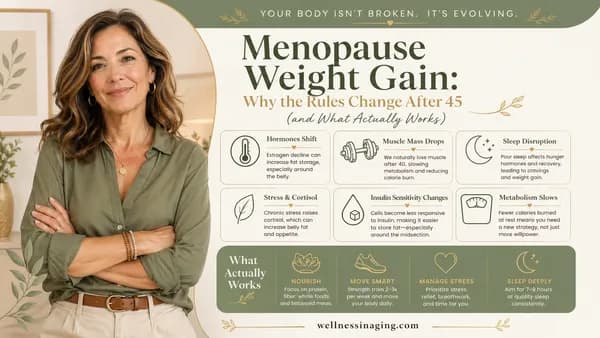
Menopause Weight Gain: Why the Rules Change After 45 (and What Actually Works)
Why menopause causes belly fat even when weight stays stable — the hormonal mechanism behind visceral fat redistribution and evidence-based strategies that work differently after 45.
Read article →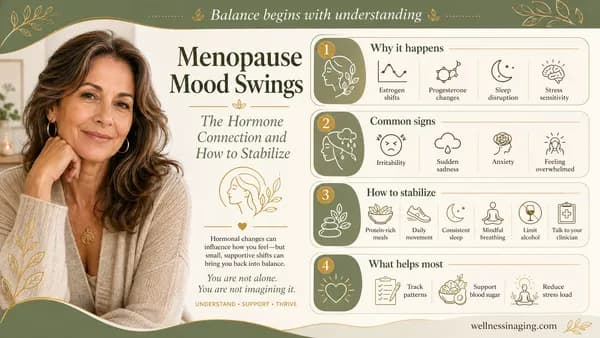
Menopause Mood Swings: The Hormone Connection and How to Stabilize
Why estrogen fluctuations cause dramatic mood changes during menopause — and evidence-based approaches from lifestyle to supplements to therapy.
Read article →
Joint Pain During Menopause: The Estrogen Connection and Natural Relief
Why declining estrogen causes joint pain during menopause — and which supplements, exercises, and lifestyle changes have clinical evidence behind them.
Read article →