
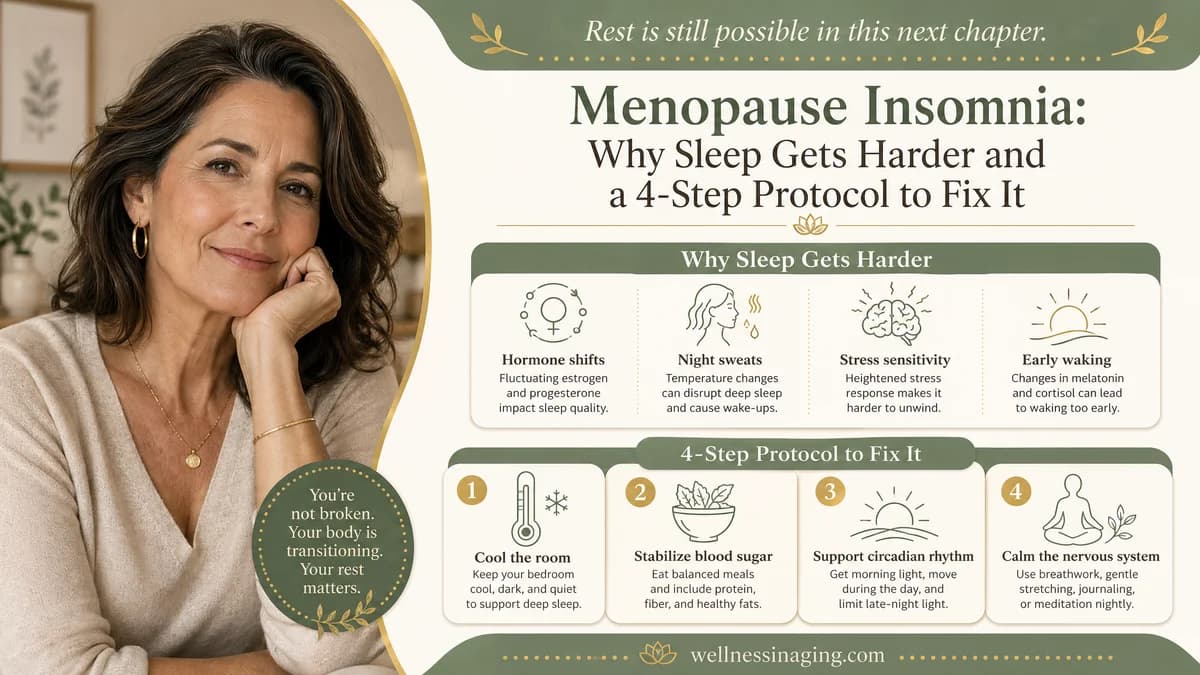
It is 3:17am. You have been staring at the ceiling for forty-three minutes. You fell asleep fine — exhausted, actually — but something pulled you awake in the small hours, and now your mind churns through tomorrow's tasks while your body lies perfectly still, waiting for sleep that refuses to come.
This pattern has a name. And more importantly, it has a cause — actually, four of them.
Menopause insomnia is not a single problem but a convergence of four distinct biological disruptions happening simultaneously. Most advice focuses on one or two. This guide addresses all four, with a specific protocol for each mechanism. You will understand exactly why your sleep has changed and what to do about it, in order of priority.
Is This Article For You?
This guide is for you if:
- You fall asleep fine but wake at 2-4am unable to fall back asleep
- Night sweats fragment your sleep 3+ times per night
- You feel "tired but wired" despite exhaustion
- Sleep problems started or worsened during perimenopause or menopause
This guide is NOT a substitute for:
- Evaluation for sleep apnea (if you snore loudly or gasp awake)
- Treatment of clinical anxiety or depression
- Medical advice for severe insomnia lasting 6+ months
Always consult your healthcare provider before starting new supplements or treatments.
Why Menopause Wrecks Your Sleep: The Four Mechanisms
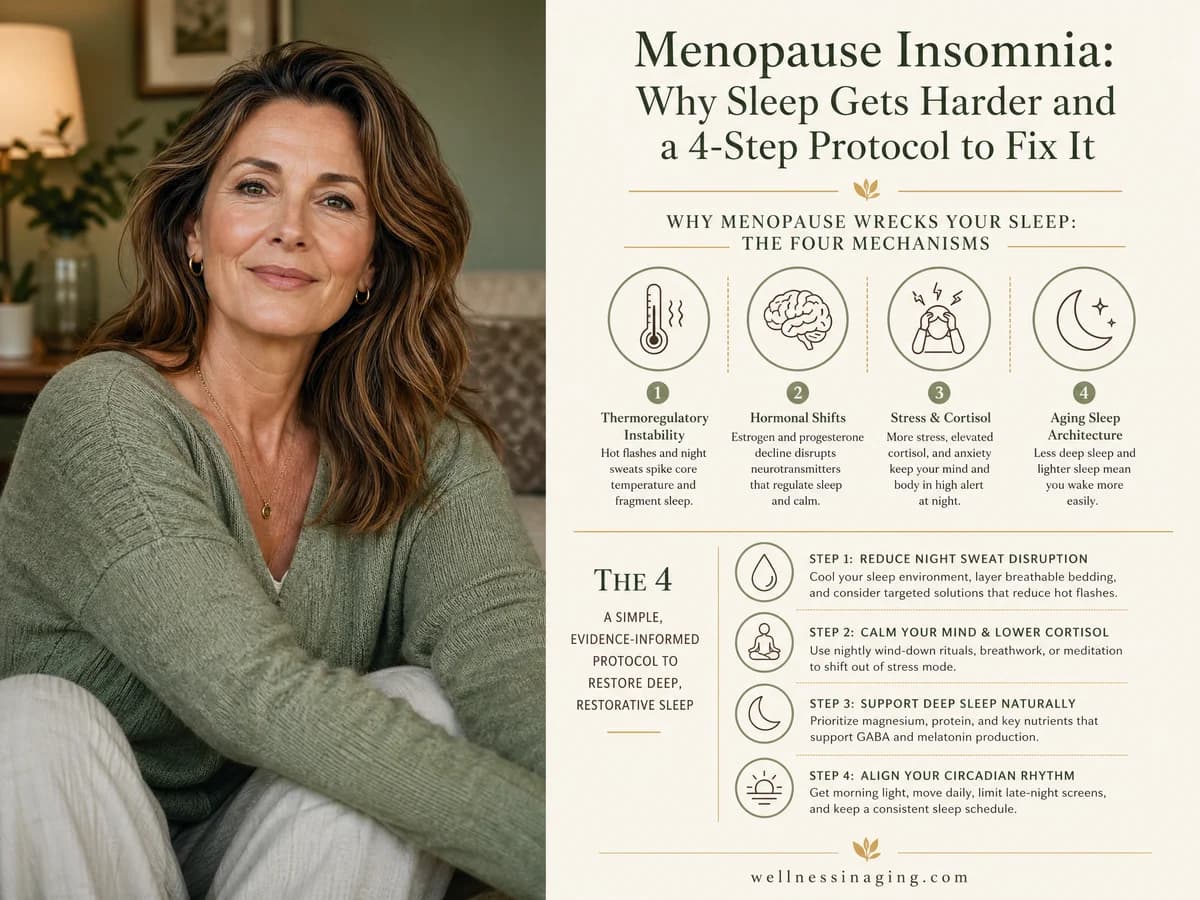
Sleep researchers have identified four separate pathways through which menopause disrupts sleep architecture. Understanding each one matters because the solution differs for each.
Mechanism 1: Vasomotor Disruption (Night Sweats) When estrogen declines, your hypothalamus — the brain's thermostat — loses its ability to regulate temperature accurately. Core body temperature rises unpredictably, triggering the vasodilation cascade you experience as a hot flash or night sweat. Each episode causes 3-5 minutes of awakening, fragmenting your sleep architecture. Women with moderate-to-severe vasomotor symptoms experience these 4-6 times per night, losing 1-2 hours of consolidated sleep (Freedman, 2005).
Mechanism 2: Elevated Evening Cortisol (The 3am Pattern) Most articles miss this: the 3am wake-up is often not about temperature at all. Perimenopause flattens your diurnal cortisol rhythm. Instead of cortisol staying low through the night and rising naturally at dawn, it begins rising hours early — pulling you into alertness at 2am, 3am, 4am. This same cortisol dysregulation is a major driver of menopause mood swings, which is why sleep and emotional regulation problems so often travel together.
If you've experienced this, you know how maddening it is. Your mind is perfectly clear, your body perfectly still, and sleep feels impossibly far away even though you were unconscious two hours earlier.
This HPA axis dysregulation explains why you feel wired despite being exhausted (Morssinkhof et al., 2020).
Mechanism 3: Progesterone Decline Progesterone is not just a reproductive hormone. It has sedative properties through its metabolite allopregnanolone, which binds to GABA-A receptors — the same receptors targeted by benzodiazepines and alcohol. When progesterone drops during perimenopause, you lose this natural sedation. Sleep onset becomes harder, and sleep feels less restorative (Joffe et al., 2010).
Mechanism 4: Circadian Rhythm Shifts Melatonin production declines approximately 10% per decade after age 40. Simultaneously, the circadian clock tends to advance — you feel sleepy earlier and wake earlier than you want. This phase advance, combined with reduced melatonin amplitude, weakens the biological signals that regulate your sleep-wake cycle (Jehan et al., 2015).
The 4-Step Protocol
Each step targets a specific mechanism. Work through them in order — the first step often provides the most immediate relief.
Step 1: Reduce Night Sweat Disruption
Targets: Mechanism 1 (Vasomotor)
If night sweats wake you multiple times per night, no amount of supplements or sleep hygiene will compensate until you address this mechanical disruption.
Bedroom Temperature Set your room to 60-67°F (15.5-19.5°C). Research shows each 1°C increase above 20°C reduces sleep efficiency by 3-5% (Okamoto-Mizuno & Mizuno, 2012). For women with night sweats, aim for the lower end: 60-63°F.
Layering System
- Base layer: moisture-wicking fitted sheet (bamboo or Tencel)
- Pajamas: lightweight, breathable, button-front for easy removal
- Light blanket: easily kickable
- Bedside: extra pajama set, small towel, water bottle
Active Cooling Options Active cooling systems like ChiliPad, BedJet, or Eight Sleep maintain consistent temperature despite vasomotor episodes. These are expensive ($400-900+) but mechanistically sound for women with 4+ night sweat episodes nightly. Evidence rating: MODERATE (strong rationale, limited RCTs).
Consider HRT Discussion If night sweats are severe (4+ per night, impacting daily function), hormone replacement therapy reduces VMS frequency by 70-80%. Oral micronized progesterone taken at bedtime provides dual benefit: VMS reduction plus sedative effect. This is a conversation for your healthcare provider, not a supplement decision. Evidence rating for VMS-driven insomnia: STRONG (NAMS, 2022).
Step 2: Lower Evening Cortisol
Targets: Mechanism 2 (HPA Dysregulation)
The 3am wake-up responds poorly to sleep supplements but well to cortisol-lowering interventions started in the evening.
Screen Cutoff: 90 Minutes Before Bed Blue light from screens suppresses melatonin, but the larger issue is cognitive activation. Work emails, social media conflict, and engaging content all spike cortisol when you need it declining. Set a hard boundary 90 minutes before bed.
Magnesium Glycinate: 200-400mg Before Bed Magnesium modulates the HPA axis, reducing cortisol response to stress. It also acts as a mild GABA-A receptor agonist, providing calming effects without sedation. A 2012 RCT found magnesium improved sleep efficiency by 12% and reduced early morning awakening (Abbasi et al., 2012).
- Form matters: use glycinate or bisglycinate, not oxide (poor absorption, laxative effect)
- Start at 200mg, increase to 400mg if tolerated
- Take 1-2 hours before bed
- Timeline: some notice calming within days; sleep quality improvement typically takes 2-4 weeks
- Evidence rating: MODERATE
Yoga Nidra or NSDR (Non-Sleep Deep Rest) These guided relaxation protocols reduce physiological arousal markers more effectively than standard meditation. A 20-30 minute session before bed or after a middle-of-night awakening can help reset the nervous system. Free protocols are available on YouTube (search "yoga nidra" or "NSDR Andrew Huberman").
Ashwagandha: 300-600mg Daily This adaptogen reduces cortisol by approximately 28% in chronically stressed adults (Salve et al., 2019). An 8-week RCT found ashwagandha improved sleep quality scores by 72% vs 29% for placebo (Deshpande et al., 2020). Take in evening or split between morning and evening. Evidence rating: MODERATE.
Step 3: Support Progesterone's Sleep Role
Targets: Mechanism 3 (GABA-ergic Decline)
When progesterone drops, you lose natural GABA-A receptor stimulation. You can partially compensate through supplements that support GABAergic tone, or discuss bioidentical progesterone with your provider.
Bioidentical Progesterone (Prescription) Oral micronized progesterone (brand name Prometrium) taken at bedtime has documented sedative effects — this is why providers specifically recommend nighttime dosing. If you are a candidate for HRT, discuss whether progesterone alone might address your sleep issues. This requires a prescription and medical supervision.
L-Theanine: 200mg Before Bed This amino acid from green tea increases GABA, serotonin, and dopamine while promoting alpha wave activity. It provides a calming effect without sedation. A 2019 RCT found L-theanine improved sleep quality in adults with stress-related sleep disturbance (Hidese et al., 2019).
- Dosage: 200mg, taken 30-60 minutes before bed
- Can be combined with magnesium glycinate
- Timeline: acute calming effect within 30-60 minutes; sleep quality improvements over 1-4 weeks
- Evidence rating: MODERATE
Note on 5-HTP 5-HTP is sometimes recommended for sleep because it is a serotonin precursor. However, it carries significant interaction risks with SSRIs, SNRIs, and MAOIs (serotonin syndrome). If you take any antidepressant, do not use 5-HTP without medical supervision. For most women, magnesium and L-theanine are safer first choices.
Step 4: Protect Your Circadian Rhythm
Targets: Mechanism 4 (Melatonin/Circadian Shifts)
Circadian rhythm disruption is subtle but cumulative. These interventions take 1-2 weeks to show effects but provide foundational support for all other sleep improvements.
Morning Light: 10-20 Minutes Within an Hour of Waking Light exposure through the eyes in the morning sets your circadian clock. Get outside or sit by a bright window — overcast days still provide sufficient lux. Light boxes (10,000 lux) can substitute in winter or northern latitudes. This is the single most effective circadian intervention and costs nothing.
Consistent Wake Time (Non-Negotiable) Your wake time is the most important anchor for your circadian rhythm. Pick a time and hold it within 30 minutes every day, including weekends.
I know this feels brutal when you're already exhausted. Sleeping in on Saturday and Sunday creates "social jet lag" that disrupts the following week. The two hours of recovery sleep cost you three nights of worse sleep. Not worth it.
Low-Dose Melatonin: 0.5-1mg, Consistent Timing Melatonin works as a timing signal, not a sedative. Low doses (0.5-1mg) taken at a consistent time each evening help reinforce circadian phase. Higher doses (5-10mg) are not more effective and may cause grogginess or vivid dreams.
- Take 30-60 minutes before desired sleep time
- Same time every night matters more than dose
- Timeline: phase-shifting requires 1-2 weeks of consistent use
- Evidence rating: MODERATE for sleep onset; WEAK for sleep maintenance
Fixed Pre-Sleep Routine Your brain needs consistent cues that sleep is approaching. Develop a 30-45 minute wind-down routine you perform in the same order each night: dim lights, change clothes, brush teeth, brief stretching or reading. The specific activities matter less than consistency.
Supplements Summary: Evidence Ratings
| Supplement | Dosage | Evidence | Best For |
|---|---|---|---|
| Magnesium glycinate | 200-400mg | MODERATE | Anxiety-driven insomnia, cortisol, early waking |
| L-Theanine | 200mg | MODERATE | Stress-related sleep difficulty, "tired but wired" |
| Melatonin | 0.5-1mg | MODERATE | Sleep onset; circadian phase correction |
| Ashwagandha | 300-600mg | MODERATE | Chronic stress, elevated cortisol, HPA dysregulation |
| Valerian root | 300-600mg | WEAK | Skip this — SMD=0.17 in meta-analysis, mostly placebo |
Evidence ratings based on systematic reviews and RCTs. MODERATE indicates consistent effects in multiple studies but limited high-quality data specifically in menopausal populations.
What Does Not Work
Being honest about what fails saves you money and frustration.
High-Dose Melatonin (5-10mg) More is not better. Doses above 3mg do not improve efficacy and increase side effects (grogginess, vivid dreams, headache). Adults are not melatonin-deficient; you are trying to send a timing signal, not flood receptors. Stick to 0.5-1mg.
Alcohol as a Sleep Aid Alcohol is a sedative that helps you fall asleep faster. The problem comes later: as your liver metabolizes alcohol (2-4 hours), you experience rebound arousal — fragmented sleep, suppressed REM, and early morning awakening. Alcohol also worsens night sweats by dilating blood vessels. Never use alcohol for sleep.
Antihistamines Long-Term (Benadryl, ZzzQuil) Diphenhydramine helps you fall asleep the first few nights. Then tolerance develops within 3-7 days of nightly use. Worse, antihistamines carry significant anticholinergic burden in adults over 50: cognitive impairment, dry mouth, urinary retention, and increased fall risk. The American Geriatrics Society Beers Criteria lists them as potentially inappropriate for older adults (Glass et al., 2005). Occasional use is fine; nightly use is not.
Sleeping In on Weekends "Catching up" on sleep by sleeping until 10am Saturday and Sunday creates circadian havoc. Your body cannot distinguish weekend from weekday. The recovery sleep does not compensate for the disruption to your Monday-through-Wednesday sleep quality.
Keep your wake time within 30 minutes daily. Yes, even when you've been managing this for months or years and feel like you deserve a break. Your circadian system doesn't negotiate.
Herbal Blend Products Products containing 8-12 herbs at underdosed levels have no clinical trials validating the specific formulation. You cannot identify what helps, what does nothing, and what causes side effects. Choose single-ingredient supplements with documented efficacy at studied doses.
When to Seek Professional Help
Some sleep problems require medical evaluation, not self-treatment.
Sleep Apnea Screening Sleep apnea prevalence doubles after menopause (from 9% to 20-40%) due to progesterone loss affecting upper airway muscle tone, weight redistribution, and aging. Warning signs: loud snoring, witnessed breathing pauses, waking with gasping, excessive daytime sleepiness despite adequate sleep time. If present, request a sleep study — supplements cannot treat apnea. Related: menopause fatigue.
CBT-I Referral Cognitive Behavioral Therapy for Insomnia is the gold standard treatment with 60-80% remission rates at 6-month follow-up — better outcomes than sleep medications with no side effects or dependence.
Consider CBT-I if:
- Insomnia persists more than 3 months
- Sleep efficiency is below 75% (time asleep divided by time in bed)
- You have developed anxiety about sleep itself
Digital CBT-I apps (Sleepio, Somryst) provide 70-80% of in-person effectiveness at lower cost. The Society of Behavioral Sleep Medicine maintains a provider directory at behavioralsleep.org.
Red Flags Requiring Evaluation
- Hot flashes that started suddenly under age 40 (possible premature ovarian insufficiency)
- Irresistible daytime sleep attacks (possible narcolepsy or severe apnea)
- Acting out dreams physically (possible REM sleep behavior disorder)
- Insomnia with rapid weight loss, night sweats, or other systemic symptoms
For more on stress and sleep connections, see our guide on menopause sleep hygiene.
Free Download: Menopause Starter Guide A practical guide covering symptoms, evidence-rated remedies, and questions to bring to your next appointment. Download free
The Bottom Line
Menopause insomnia results from four converging mechanisms, and addressing only one or two leaves you fighting a losing battle. Start with temperature management if night sweats wake you multiple times nightly — this provides the most immediate relief. Add magnesium glycinate 200mg tonight; it addresses cortisol, GABA, and overall sleep quality with a strong safety profile. Protect your circadian rhythm with morning light and consistent wake times, even on weekends.
If self-management does not produce meaningful improvement within 4-6 weeks, consider CBT-I (digital apps or a trained provider) before adding more supplements. And if night sweats remain severe despite cooling strategies, bring this article to your next appointment and discuss whether HRT makes sense for your situation.
Want evidence-based menopause guidance in your inbox? Subscribe to our newsletter for weekly tips on managing symptoms, supplement reviews, and what actually works.
References
Abbasi et al., J Res Med Sci, 2012 | Deshpande et al., Sleep Med, 2020 | Freedman, Semin Reprod Med, 2005 | Glass et al., BMJ, 2005 | Hidese et al., Nutrients, 2019 | Jehan et al., J Sleep Disord Ther, 2015 | Joffe et al., Semin Reprod Med, 2010 | Morssinkhof et al., Neurosci Biobehav Rev, 2020 | NAMS Position Statement, Menopause, 2022 | Okamoto-Mizuno & Mizuno, J Physiol Anthropol, 2012 | Salve et al., Medicine, 2019
This content is for informational purposes only and does not constitute medical advice. Always consult with a qualified healthcare provider before starting any new supplement or treatment. Individual results may vary.
Free Download
The Menopause Supplement Evidence Guide
Which supplements have real research behind them. 12 pages, free.
Frequently Asked Questions
Related Articles
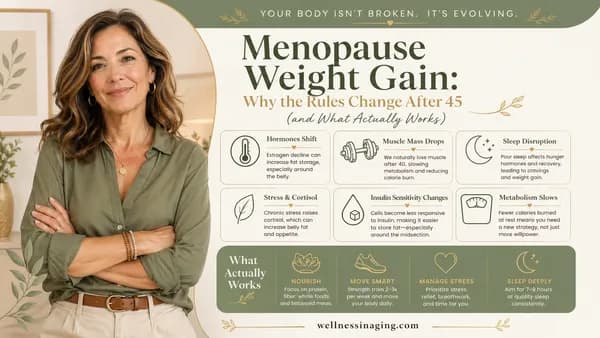
Menopause Weight Gain: Why the Rules Change After 45 (and What Actually Works)
Why menopause causes belly fat even when weight stays stable — the hormonal mechanism behind visceral fat redistribution and evidence-based strategies that work differently after 45.
Read article →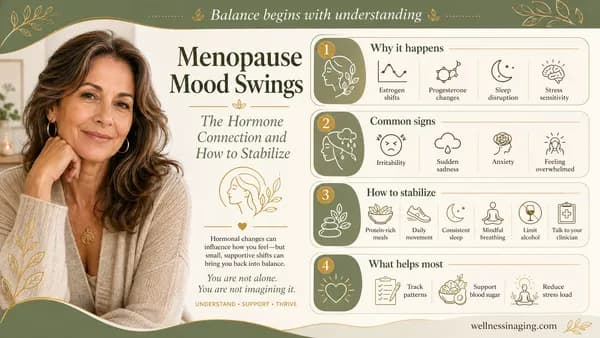
Menopause Mood Swings: The Hormone Connection and How to Stabilize
Why estrogen fluctuations cause dramatic mood changes during menopause — and evidence-based approaches from lifestyle to supplements to therapy.
Read article →
Joint Pain During Menopause: The Estrogen Connection and Natural Relief
Why declining estrogen causes joint pain during menopause — and which supplements, exercises, and lifestyle changes have clinical evidence behind them.
Read article →