
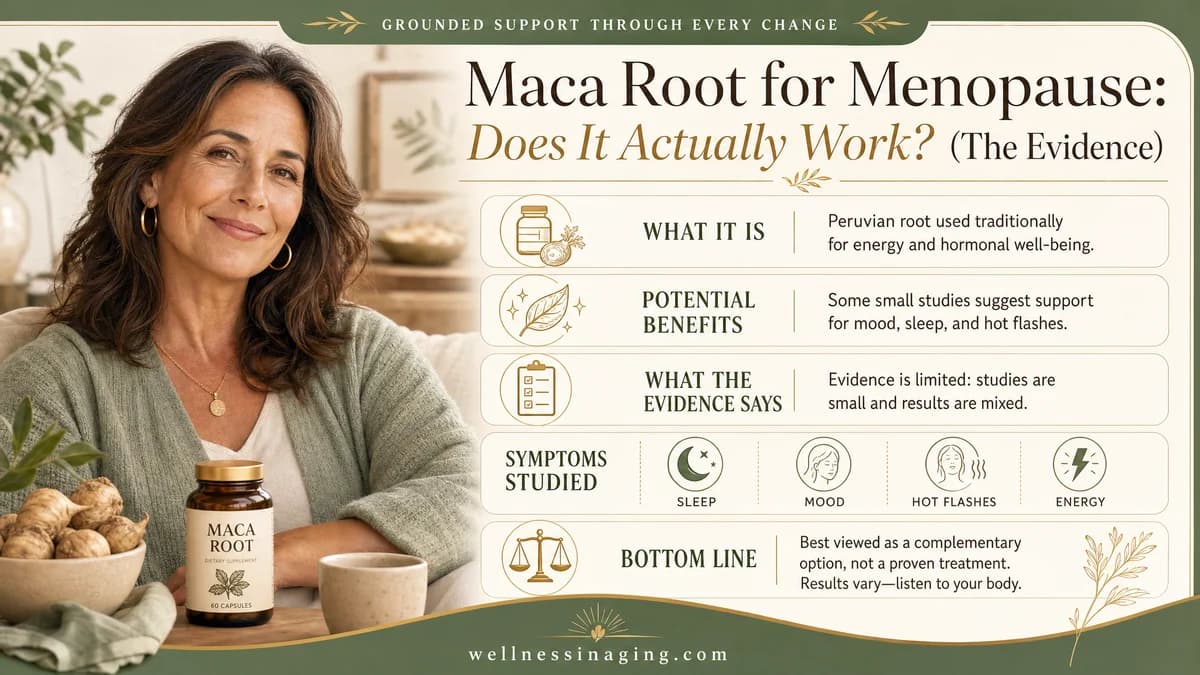
Maca root is one of the most Googled menopause supplements — and also one of the most misunderstood. If you've been searching for natural libido help or mood support during menopause, you've probably seen maca recommended on forums, by naturopaths, or in supplement roundups. The marketing often claims it "balances hormones naturally."
Here's what that marketing doesn't tell you: maca contains zero hormones and zero phytoestrogens. It doesn't work like soy or black cohosh. It won't replace estrogen. And if hot flash relief is your main goal, the evidence says maca probably won't help much.
But that doesn't mean maca is useless. There's real clinical trial data showing it may genuinely help with sexual dysfunction, libido, and mood — just through a completely different mechanism than most women expect. Below: what maca actually does in your body, what the randomized controlled trials found for each menopause symptom, the correct form and dose that studies used, and who should avoid it entirely.
How Maca Works: Not Through Hormones
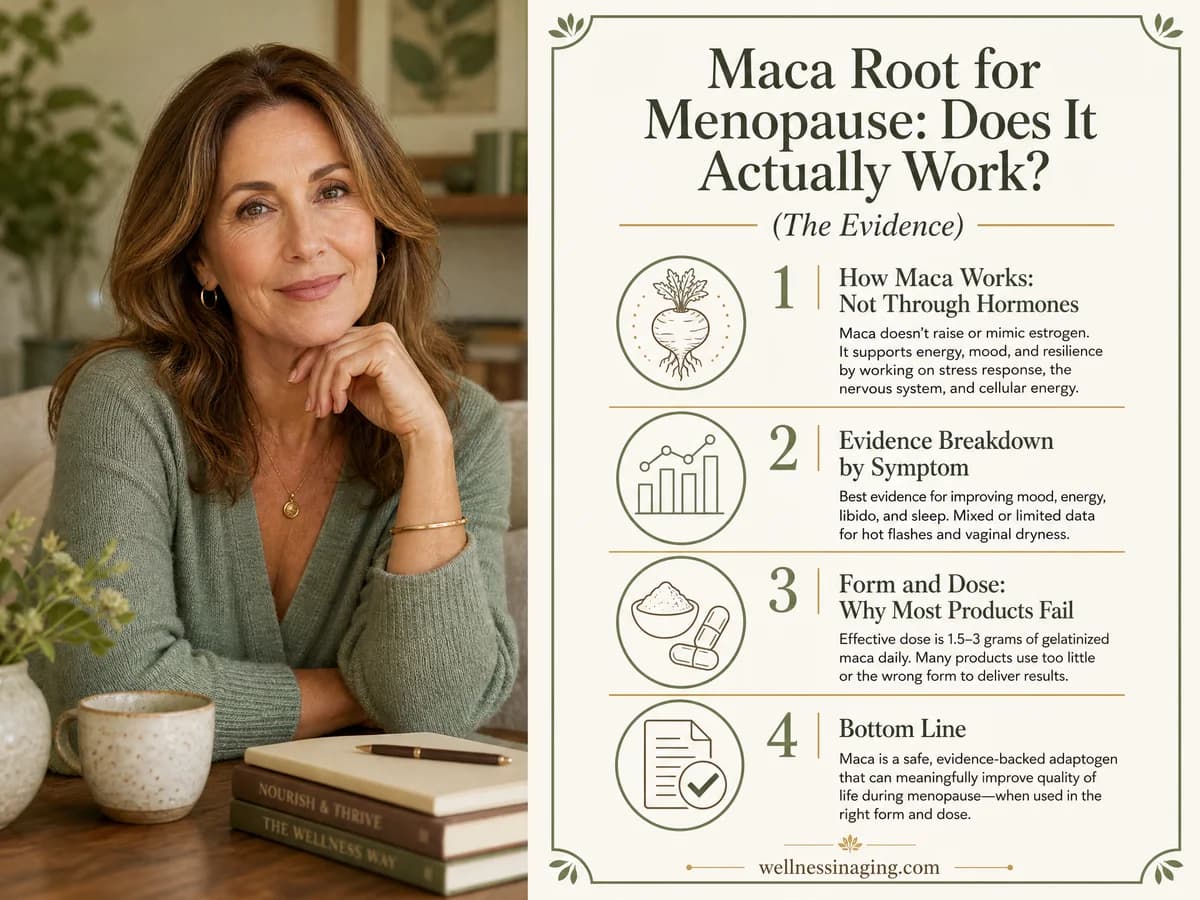
The most important thing to understand about maca (Lepidium meyenii) is what it doesn't do. Despite years of marketing claims, multiple clinical trials have confirmed that maca does not affect your hormone levels.
A 2008 study in Menopause journal measured estradiol, FSH, LH, and testosterone in postmenopausal women taking maca for six weeks. No changes. A 2015 study in Climacteric found the same — no hormonal shifts. Research from Gonzales and colleagues in 2005 confirmed that maca has no direct activity on estrogen, progesterone, or androgen receptors (1, 2, 3).
So why does maca do anything at all?
The answer lies in your brain, not your ovaries. Maca contains unique compounds called glucosinolates (the same family found in broccoli and kale, but with a distinct profile) and macamides/macaenes (found only in maca). These compounds appear to influence the hypothalamic-pituitary axis — the control center that regulates mood, stress response, and sexual function.
Animal studies show maca affects hypothalamic neurotransmitters including dopamine, serotonin, and norepinephrine (4). This explains why it may improve mood and libido without changing hormone levels. Think of it as working on the brain's "software" rather than replacing the hormonal "hardware" that menopause removes.
Maca is also classified as an adaptogen, meaning it may help your body adapt to stress by modulating the HPA (hypothalamic-pituitary-adrenal) axis. Since menopause often involves HPA dysregulation and elevated cortisol, this pathway could indirectly ease some symptoms.
Evidence Breakdown by Symptom
Not all menopause symptoms respond equally to maca. Here's what the randomized controlled trials actually found.
Sexual Dysfunction and Libido — Evidence: MODERATE
This is where maca has its strongest evidence. Three key studies support its use for low libido during menopause:
Brooks et al. 2008 gave 14 postmenopausal women 3.5g/day of gelatinized maca for six weeks in a crossover trial. Sexual dysfunction scores improved significantly on the Greene Climacteric Scale. Critically, hormone levels remained unchanged — confirming the effect came through non-hormonal pathways (1).
Dording et al. 2008 tested maca in adults with SSRI-induced sexual dysfunction (including postmenopausal women). The key finding: 3.0g/day worked, but 1.5g/day did not. This dose-dependent response tells us that low-dose products likely won't help (5).
Gonzales-Arimborgo et al. 2016 studied 175 adults taking either black maca, red maca, or placebo at 3g/day for 12 weeks. Both maca types improved sexual desire compared to placebo, with black maca showing a slightly stronger effect (6).
The pattern across these studies: effects emerge at 6-12 weeks, not overnight. The effective dose is 3.0-3.5g/day. And the mechanism is clearly not hormonal.
Bottom line: If low libido is your primary menopause complaint, maca has reasonable evidence behind it. But you need patience (8-12 weeks), the right dose (3g minimum), and realistic expectations — it's not a replacement for addressing vaginal atrophy, relationship factors, or other underlying causes.
Mood and Anxiety — Evidence: MODERATE
Multiple trials show consistent mood benefits from maca:
- Brooks et al. 2008: Anxiety and depression scores reduced significantly (1)
- Stojanovska et al. 2015: Depression scores dropped on the Beck Depression Inventory (2)
- Meissner et al. 2005: Psychological symptoms improved across the board (7)
The proposed mechanism involves maca's effects on hypothalamic neurotransmitters and its adaptogenic stress-buffering properties. A small pilot study by Stone et al. (2009) found maca reduced cortisol and improved perceived stress, though this was in athletes rather than menopausal women (8).
Bottom line: Maca shows consistent — if modest — benefits for mood and anxiety. The effect size is smaller than SSRIs or ashwagandha, so it's best suited for mild-to-moderate symptoms rather than clinical depression. It's worth noting that the same HPA dysregulation driving these mood effects also underlies menopause mood swings more broadly — which is why maca tends to help emotional symptoms as a cluster rather than in isolation.
Hot Flashes and Night Sweats — Evidence: WEAK
Here's where the marketing diverges from reality. Despite being promoted for "menopause symptom relief," maca performs poorly for vasomotor symptoms specifically.
Meissner et al. 2005 found hot flash frequency showed only a modest, non-significant reduction. Hot flash severity? Clinically minimal improvement (7).
Stojanovska et al. 2015 was even clearer: hot flashes showed NO significant reduction despite 12 weeks of supplementation (2).
Why the disconnect? "Menopausal symptom relief" is not the same as "hot flash relief." Maca may help mood and libido (which are menopause symptoms), but thermoregulation appears to require different pathways — likely ones that respond to actual estrogen or estrogen-like compounds.
Better alternatives for hot flashes:
- Black cohosh: 26% reduction vs. placebo (moderate evidence)
- Soy isoflavones: 20-25% reduction in equol-producers (moderate evidence)
- HRT: 75-90% reduction (strong evidence)
- Fezolinetant (Veozah): 60-65% reduction (strong evidence)
Bottom line: If night sweats and hot flashes are your primary concern, maca is not your answer. Look to black cohosh, soy, or discuss HRT with your provider.
Cognitive Function — Evidence: INSUFFICIENT
One small human pilot (N=20) suggested improvements in processing speed and attention at 12 weeks. But most evidence comes from animal studies showing maca affects hypothalamic neurotransmitter activity.
Bottom line: Interesting preliminary signals, but not enough human data to recommend maca specifically for brain fog.
Bone Density — Evidence: INSUFFICIENT
Meissner et al. 2005 found favorable changes in bone formation markers (alkaline phosphatase, osteocalcin) and reduced bone resorption markers. But here's the problem: the study was only 12 weeks long, and no actual bone density scans (DEXA) were performed (7).
Bone changes take years to manifest. Biomarker changes don't guarantee real bone density improvements.
Bottom line: Preliminary biomarker data is interesting, but maca is not a proven bone health intervention. For actual bone protection, focus on vitamin D, vitamin K2, magnesium, weight-bearing exercise, and discuss bisphosphonates or HRT with your provider if you're at risk.
Form and Dose: Why Most Products Fail
Most maca products on the market are under-dosed or use the wrong form. Here's what the clinical trials actually used.
| Form | Goitrogen Content | Digestibility | Clinical Evidence | Best For |
|---|---|---|---|---|
| Raw maca powder | High | Poor (causes gas/bloating) | Limited | Traditional use; avoid if thyroid concerns |
| Gelatinized maca | Reduced 50-70% | Good (starch removed) | Most studies use this | Recommended — matches clinical trials |
| Yellow maca | Moderate | Varies | Most common in studies | General mood/energy support |
| Red maca | Moderate | Varies | Limited human data | Preliminary bone/prostate interest |
| Black maca | Moderate | Varies | Emerging evidence | Libido/sexual function (slightly stronger) |
Gelatinized vs. raw: "Gelatinized" doesn't mean it contains gelatin — it's vegan. The term refers to heat processing that removes starch, making it 4:1 concentrated. This improves digestion (raw maca causes significant gas in many users), reduces goitrogen content (important for thyroid safety), and matches what clinical trials used. Choose gelatinized.
Color types: Black maca showed slightly stronger effects for sexual desire in the Gonzales-Arimborgo study. If libido is your goal, black maca is worth the extra cost. Yellow maca is fine for general mood/energy. Red maca has preliminary animal data for bone health but limited human evidence.
Effective dose: 3.0-3.5g/day of gelatinized maca. The Dording study explicitly showed 1.5g/day was ineffective — only 3.0g worked. Most commercial capsules are 500mg, meaning you need 6-7 capsules daily to reach therapeutic dose. If using powder, that's roughly half a tablespoon.
Timing: Take in the morning with food. Some users report mild stimulating effects that can interfere with sleep if taken late.
Realistic Timeline: When to Expect Results
Maca is not fast-acting. Understanding this prevents premature discontinuation.
Weeks 1-2: No noticeable effect. This is normal.
Weeks 3-4: Some women notice subtle energy or mood shifts. Very subtle.
Weeks 6-8: Mood and anxiety benefits typically emerge. This is when Brooks and colleagues saw psychological symptom improvements.
Weeks 8-12: Sexual function improvements appear — if they're going to. The Gonzales-Arimborgo study showed peak libido effects around 12 weeks.
Months 3-6: If you haven't noticed benefits by 12 weeks, they probably won't develop. Consider discontinuing and trying alternatives.
The most common mistake: women quit after 2 weeks, write "doesn't work" reviews, when they simply didn't wait long enough for a slow-acting supplement that modulates brain pathways rather than directly replacing hormones.
What Maca Won't Do (Honest Limitations)
Building trust means being clear about what doesn't work.
Maca will NOT replace HRT. It doesn't affect estrogen, progesterone, or testosterone levels. It won't prevent vaginal atrophy, won't protect bone density to the same degree as hormone therapy, and won't significantly reduce hot flashes.
Low doses don't work. Products with 500-1000mg per serving are under-dosed based on clinical evidence. You need 3g minimum, which means 6 capsules of most products or a measured tablespoon of powder.
Raw maca is problematic for thyroid-sensitive women. The goitrogen content is significantly higher than gelatinized forms. "More natural" doesn't mean safer.
Maca won't cause weight loss. There's no evidence it boosts metabolism. Any indirect benefit (improved mood leading to less stress eating) is speculative.
Marketing claims of "hormone balancing" are false. Every study measuring actual hormone levels found no changes. Maca works through central nervous system pathways, not hormonal ones.
Who This Is For — and Who Should Skip It
Good candidates for maca:
- Women whose primary menopause complaint is low libido or sexual dysfunction
- Women with mild-to-moderate mood symptoms (anxiety, irritability, low mood)
- Women who want to try a non-hormonal option before considering prescription treatments
- Women without thyroid conditions who can commit to 8-12 weeks of consistent use
Skip maca and try something else if:
- Hot flashes and night sweats are your primary concern (try black cohosh or discuss HRT)
- You have hypothyroidism, Hashimoto's, or take thyroid medication
- You want fast results (maca takes 8-12 weeks)
- You're looking for a hormone replacement (maca doesn't replace hormones)
See your doctor first if:
- You have any thyroid condition or are on thyroid medication
- You have a history of hormone-sensitive breast cancer (theoretical concern, though no evidence maca stimulates ER+ cells)
- You're pregnant or breastfeeding (no safety data available)
Download the Menopause Starter Guide →
The Bottom Line
Maca has a specific niche: it may genuinely help with low libido and mood symptoms during menopause, with moderate clinical evidence supporting these uses. But it won't reduce hot flashes, won't replace hormones, and won't work at the low doses found in most commercial products.
If you decide to try it: choose gelatinized maca (black maca specifically if libido is your focus), take 3g/day minimum, commit to 12 weeks before judging effectiveness, and avoid it entirely if you have thyroid issues. Pairing maca with an anti-inflammatory diet may also support the mood and energy pathways maca targets — the two approaches work on complementary mechanisms.
If hot flashes are your main concern, you're better served by black cohosh or discussing hormone therapy options with your provider. For a broader view of what works and what doesn't, see our complete menopause supplements guide.
Download the Menopause Starter Guide →
Related: Black Cohosh for Menopause | Ashwagandha for Menopause | Best Menopause Supplements
References
Brooks et al., Menopause, 2008 | Stojanovska et al., Climacteric, 2015 | Gonzales et al., Andrologia, 2005 | Rubio et al., Evidence-Based Complementary and Alternative Medicine, 2011 | Dording et al., CNS Neuroscience & Therapeutics, 2008 | Gonzales-Arimborgo et al., Pharmaceuticals (Basel), 2016 | Meissner et al., International Journal of Biomedical Science, 2005 | Stone et al., Pharmacological Research, 2009
This content is for informational purposes only and does not constitute medical advice. Always consult with a qualified healthcare provider before starting any new supplement or treatment. Individual results may vary.
Free Download
The Menopause Supplement Evidence Guide
Which supplements have real research behind them. 12 pages, free.
Frequently Asked Questions
Related Articles
Probiotics and Menopause: The Gut-Hormone Connection (What the Science Says)
Your gut bacteria directly regulate estrogen metabolism through the estrobolome. Here's what probiotics can and can't do for menopause — with strain-specific evidence for bone health, mood, and vaginal health.
Read article →
Omega-3 for Menopause: What It Helps With (and What It Doesn't)
Omega-3s have strong evidence for mood, joint pain, and heart health during menopause — but NOT for hot flashes. Here's the RCT data, the correct EPA vs DHA dose by symptom, and how to avoid rancid fish oil.
Read article →
Evening Primrose Oil for Menopause: The Honest Evidence Review
Two high-quality RCTs show evening primrose oil does NOT reduce hot flashes. Here's what the science says, why it's still widely recommended, and what actually works instead.
Read article →