
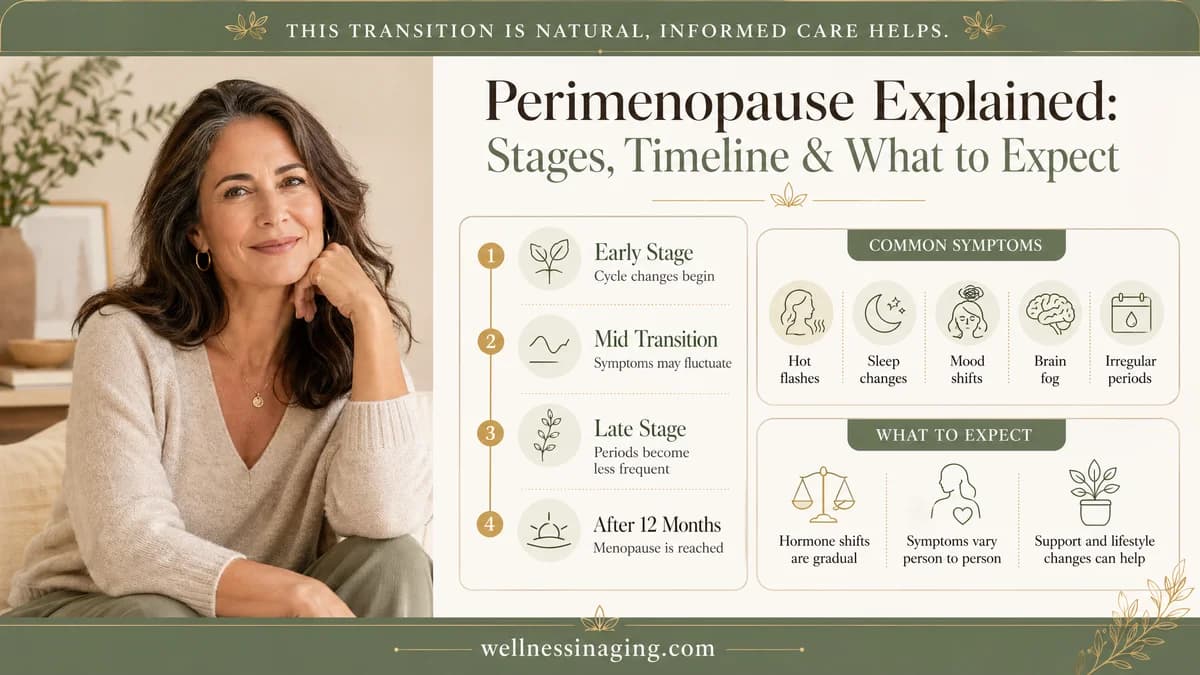
The first sign of perimenopause is almost never a hot flash. For most women, it is a Tuesday night at 3:14 a.m., wide awake, heart slightly fast, no obvious reason. Then it happens again the next week. Then it becomes a pattern. Months — sometimes years — before a single period skips, sleep starts to come apart at the seams. Doctors miss it. Partners miss it. Most women miss it themselves and assume they are just stressed.
That sleep-first pattern is one of the most under-discussed truths about perimenopause, and it is the reason so many women describe the early years as "feeling like I was losing my mind" before anyone gave the experience a name.
Most women come to this stage having been told almost nothing about what to expect — not by their mothers, not by their doctors. What follows is everything you actually need to know: what perimenopause is, when it tends to start, how long it lasts, the stages you can use to locate yourself in the transition, the hormonal surge most women have never heard about, and a short script you can take to your next doctor's appointment.
What Perimenopause Actually Is

Perimenopause is the transition phase before menopause. It is not a single event. It is a span of years during which your ovaries gradually wind down their reproductive function, and your hormones — primarily estrogen and progesterone — start behaving erratically before settling into their post-reproductive baseline.
Here is the simplest way to hold the distinction:
- Perimenopause = you are still having periods, even if they are irregular. Hormones are shifting. Symptoms can be intense.
- Menopause = a single point in time, defined as 12 consecutive months without a menstrual period. You do not "have menopause" for years. You cross it once.
- Postmenopause = every day after that 12-month mark.
This means most of what people casually call "menopause" is actually perimenopause. The years of hot flashes, mood swings, and changing periods happen in the perimenopausal window, not after it.
When Perimenopause Starts
The average age of perimenopause onset in Western populations is approximately 47.5 years, with most women entering the transition between 47 and 51 (Harlow et al., 2012, SWAN). Menopause itself — the 12-months-without-a-period mark — occurs at a median age of 51.3 in the U.S.
But averages hide a wide range. Perimenopause can begin anywhere from the mid-30s to the mid-50s. About 10% of women experience natural menopause before age 45, which is classified as "early menopause."
There is one important distinction to make at the younger end of the range:
Premature Ovarian Insufficiency (POI) — when ovarian function declines before age 40 — is not the same as early perimenopause. POI affects approximately 1% of women and has different implications for cardiovascular health, bone health, and fertility. If you are under 40 and experiencing irregular cycles, hot flashes, or symptoms that look like perimenopause, this needs to be evaluated by a clinician, not assumed to be a "head start" on a normal transition.
Smoking shifts the timeline earlier by roughly 1.5 to 2 years (Mishra et al., 2009). Genetics, surgical history, and certain autoimmune conditions also affect timing.
How Long Perimenopause Lasts
The total duration of perimenopause typically runs 4 to 10 years, with an average of around 7 years (NAMS).
That length surprises most women. The reason for the wide range is that "perimenopause" includes both the early phase — when periods are still regular but hormones are starting to shift — and the late phase, when cycles become long and unpredictable. Some women move through the early phase quietly and only notice symptoms in the final 2 to 3 years before their last period. Others feel the full arc.
If your mother or older sister moved through perimenopause quickly or slowly, you may follow a similar pattern. Family timing is a rough but real indicator. Not a guarantee — just a hint worth knowing.
The STRAW+10 Stages: Where Are You Right Now?
Clinicians use a framework called STRAW+10 (Stages of Reproductive Aging Workshop + 10) to map the female reproductive lifespan. It is the international consensus standard, and it is genuinely useful for women trying to figure out where they are in the transition.
Here is the readable version:
| Stage | Name | What's Happening | What You Notice |
|---|---|---|---|
| -3a | Peak Reproductive | Regular cycles, peak fertility | Nothing menopause-related |
| -2 | Late Reproductive | Subtle cycle length changes, FSH starting to rise | Possibly: sleep changes, PMS shifts, breast tenderness |
| -1 Early | Early Perimenopause | Cycle length varies by 7+ days in 2 of 10 cycles | Irregular periods begin, sleep disruption, mood shifts, possible early hot flashes |
| -1 Late | Late Perimenopause | Cycles 60+ days apart, dramatic variability, FSH high | Skipped periods, vasomotor symptoms common, brain fog, anxiety |
| 0 | Final Menstrual Period | The last period (confirmed only in retrospect) | You will not know it was the last one for a year |
| +1 | Early Postmenopause | First 5-6 years after final period | Hot flashes often peak here, then decline |
| +2 | Late Postmenopause | Stable low estrogen | Most vasomotor symptoms ease; bone and cardiovascular focus increases |
The single most useful staging marker for early perimenopause is a change in cycle length of 7 or more days from your normal pattern, occurring in at least 2 of your last 10 cycles. If you used to have 28-day cycles and you have had a 21-day cycle and a 36-day cycle in the last 10 months, you are almost certainly in early perimenopause regardless of what any single blood test says.
The Estradiol Surge Most Women Never Hear About
Here is the part of perimenopause almost no one explains: estrogen does not simply decline. It surges — sometimes to levels higher than your normal premenopausal peak — before it eventually falls.
Research by Hale and colleagues (2007) on what they called "luteal out-of-phase" events documented that during the menopausal transition, estradiol can spike to supraphysiologic levels. Above-normal estrogen sounds like it should feel good. It does not. It causes:
- Severe breast tenderness
- Heavier and longer periods (sometimes called flooding)
- Migraines or new-onset headaches around the cycle
- Bloating and water retention
- Mood swings that feel hormonal in a way they never did before
- Anxiety that arrives suddenly and lifts just as suddenly
- Worsening sleep in the week before your period
This is the missing piece in the standard "menopause means low estrogen" story. In early perimenopause, you can feel terrible because your hormones are too high, then crash because they swing too low, all within the same cycle. Randolph and colleagues (2011), tracking 1,251 women, confirmed that FSH rises gradually over 5 to 10 years before the final period — but estradiol behaves chaotically across the same window.
If you have ever said, "I feel like I'm hormonal, but my doctor says I'm too young for menopause" — this is exactly what is happening.
Symptoms Timeline: What Appears When
Symptoms arrive in waves, and they tend to follow a rough order. Use this as a pattern, not a prescription — there is no version of this transition that looks exactly like the textbook.
Before age 45 (or in early perimenopause, whatever your age):
- Sleep disruption — waking at 2 to 4 a.m. for no clear reason. Often the very first sign, preceding cycle changes by 2 to 3 years (Kravitz et al., 2003).
- Subtle cognitive shifts — losing words mid-sentence, walking into a room and forgetting why. Verbal memory and processing speed are the specific domains affected (Weber et al., 2011).
- Anxiety that feels new or out of proportion to your circumstances.
- Heavier periods, breast tenderness, or shorter cycles from the estradiol surges.
- Worsening PMS in the week before your period.
Ages 45 to 48 (mid-perimenopause):
- Cycle length starts varying noticeably.
- Hot flashes and night sweats begin in 14 to 23% of women in early perimenopause, climbing toward 35 to 50% in late perimenopause (McKinlay et al., 1992; SWAN).
- Mood swings intensify. The "perimenopausal rage" that women describe in forums is real and well-documented.
- Brain fog becomes harder to dismiss.
- Libido changes.
Ages 48 to 52+ (late perimenopause and final menstrual period):
- Periods skip months at a time.
- Vasomotor symptoms peak.
- Joint aches, vaginal dryness, and changes in skin and hair texture become noticeable.
- Bone density loss accelerates to roughly 2 to 3% per year in the 2 years immediately before and after the final period (Sowers et al., 2006).
If your doctor tells you that you are "too young" for symptoms because you are 41 and still having periods — they are wrong. Perimenopause symptoms commonly begin a decade before the final menstrual period.
The FSH Test Problem
The phrase "but your bloodwork is normal" appears in almost every perimenopause forum thread. If you have ever asked for a hormone test and been told your FSH is fine, only to walk out feeling dismissed despite obvious symptoms — the science is on your side.
A single FSH test is unreliable for diagnosing perimenopause. FSH fluctuates dramatically — not just from cycle to cycle, but from day to day during the transition. One blood draw can show "normal" levels in a woman whose hormones are clearly in transition by every other measure (Groff et al., 2005; NAMS).
What clinicians who specialize in menopause actually look at:
- Cycle changes over time — the STRAW+10 cycle-length criterion is more diagnostic than a single hormone level.
- Symptom pattern — sleep, mood, vasomotor symptoms in combination.
- AMH (Anti-Müllerian Hormone) — declines more linearly than FSH and is a better predictor of time-to-final-period, though it is not yet standard in primary care.
- Estradiol on cycle day 2 or 3 if you are still cycling — gives a baseline reading.
- TSH and ferritin — to rule out thyroid disease and iron deficiency, which mimic perimenopause symptoms closely enough to confuse even experienced clinicians.
The honest summary: perimenopause is primarily a clinical diagnosis based on age, cycle changes, and symptoms — not a single lab value.
Free Download: Menopause Starter Guide — Evidence-based strategies for managing symptoms, a supplement reference, and a symptom tracker to bring to your doctor. No email required.
A plain-English guide to all four stages of the menopause transition — with the STRAW+10 staging table, a symptom tracker, and a printable checklist for your first doctor's appointment. Download the Menopause Starter Guide →
What to Tell Your Doctor — A Script You Can Use
Bring this to your appointment. Adjust to your own situation.
"I'm [age]. Over the last [time period], I've noticed [list 2 to 4 specific symptoms — for example: waking at 3 a.m. several nights a week, cycles that have ranged from 22 to 41 days, new anxiety in the week before my period, breast tenderness that wasn't there a year ago].
I'd like to discuss whether this is perimenopause. I understand that a single FSH test isn't conclusive, but I'd like to track my cycles for the next 3 months using the STRAW+10 criteria, and I'd like to rule out thyroid and iron issues now with a TSH and ferritin panel.
I'd also like to know what treatment options would be appropriate for me — including hormone therapy, non-hormonal medications, and lifestyle approaches — so I can decide what to try first."
This script does three things at once: it shows you have done your research, it requests testing that will be informative rather than dismissive, and it opens the door to a real treatment conversation. Most clinicians respond to a prepared patient very differently than to a vague one.
If your doctor refuses to engage, ask for a referral to a menopause specialist. The North American Menopause Society maintains a directory of certified menopause practitioners.
Expert Perspective — What Clinicians and Research Societies Say
The NAMS 2022 Hormone Therapy Position Statement explicitly states that perimenopause symptoms can be treated — the old advice to "wait it out" is not clinically supported. For women with moderate-to-severe symptoms, the NAMS guideline supports treatment discussion at every stage of the transition, not just postmenopause.
The SWAN study (Study of Women's Health Across the Nation), which tracked over 3,000 women longitudinally through the menopause transition, provided the best evidence on symptom timing and duration. Its finding that hot flashes have a median duration of 7.4 years was a significant clinical correction from earlier estimates.
On Premature Ovarian Insufficiency, the European Society of Human Reproduction and Embryology (ESHRE) guideline (2016) recommends that all women under 40 presenting with suspected menopause symptoms receive specialist evaluation, including karyotyping and autoimmune screening, before a POI diagnosis is made. The implications for bone health and cardiovascular risk are different enough from normal perimenopause that a missed diagnosis matters.
Who This Guide Is For — and Who It Is Not For
This is for you if:
- You are between roughly 35 and 55, still having periods (even irregular ones), and noticing changes you cannot explain.
- You want to understand the transition before symptoms get worse, not after.
- You have been told you are "too young" or "fine" but you know something is shifting.
- You are preparing for a doctor's appointment and want clear language to use.
This is NOT for you if:
- You are under 40 and experiencing menopause-like symptoms — you may have Premature Ovarian Insufficiency, which requires different evaluation and management. See a clinician promptly.
- You are postmenopausal (12+ months without a period) and have any new vaginal bleeding — this requires evaluation immediately, regardless of how minor it seems.
- You are soaking through a pad or tampon in less than an hour, bleeding for more than 7 days, or passing large clots — these are red flags that need clinical assessment, not management at home.
This article is educational. It is not a substitute for personalized medical advice. Always consult your healthcare provider before starting any new treatment, supplement, or hormone therapy.
What Doesn't Work
Perimenopause comes with its own set of well-meaning but ultimately unhelpful approaches. Knowing what does not work can save you years of frustration.
Waiting for a definitive diagnosis before making changes. There is no single test that confirms perimenopause. No blood draw, no scan, no definitive marker. The STRAW+10 staging system exists precisely because clinicians recognized that waiting for laboratory proof delays useful action by years. If you are 42 with disrupted sleep and mood shifts, you do not need a positive test result to start prioritizing sleep hygiene, tracking your cycles, or talking to your doctor about options. Waiting for confirmation that may never come in a neat package is waiting for nothing.
Relying on period tracking apps to predict your cycles. Apps that work beautifully during your reproductive years are built on a fundamental assumption: that your cycles follow a predictable pattern the algorithm can learn. During perimenopause, that assumption collapses. The SWAN study documented cycle-length variability of 7 to 60+ days during the transition — variation so extreme that no algorithm can reliably predict your next period. Use tracking apps to record what happens, not to predict what will happen. The record is valuable; the predictions are not.
Treating a single hormone test as an answer. FSH and estradiol levels fluctuate dramatically during perimenopause — not just cycle to cycle, but day to day (Groff et al., 2005). A single blood draw showing "normal" FSH does not mean you are not in perimenopause. A single elevated FSH does not confirm you are. If your doctor dismisses your symptoms based on one lab result, ask for the clinical picture to be considered: age, cycle changes, symptom pattern. That combination is more diagnostic than any single number.
Expecting symptoms to follow a predictable timeline. The average duration of perimenopause is 4 to 8 years, but the actual range spans from 1 to 14 years. Some women move through the transition in 18 months; others spend a decade in the thick of it. Your mother's experience offers a rough hint, not a roadmap. Planning your life around "this should be over by age X" sets you up for disappointment when your body does not follow the average.
Dismissing symptoms as stress or normal aging without investigation. The overlap between perimenopause, thyroid dysfunction, iron deficiency, and chronic stress is significant enough that even experienced clinicians sometimes miss the distinction. But "it's probably just stress" should prompt investigation, not acceptance. A TSH and ferritin panel takes five minutes to order and rules out two common mimics. If your symptoms are perimenopause, you can begin appropriate support. If they are not, you have found something treatable. Either way, you are better off than you were while waiting.
The pattern across all of these: they share a common thread of waiting — waiting for confirmation, waiting for prediction, waiting for the transition to end on its own timeline. Perimenopause does not reward waiting. It rewards tracking, asking, and acting on incomplete information, because complete information is not coming.
The Bottom Line
If any of this sounds like your experience, the most useful next step is tracking — not waiting. Start logging your cycles, sleep, and symptoms for the next 60 days. Patterns that look invisible day-to-day become obvious on paper. Then bring that record, plus the script above, to your next appointment.
If you want to take the conversation further with data, look at the best at-home hormone test kits — the ones that measure FSH, estradiol, and AMH together give you a concrete starting point for a doctor's visit.
For the symptom side of the transition, deeper guides cover hot flashes, mood swings and perimenopausal rage, and insomnia during perimenopause. If sleep is the symptom that started everything, the guide to magnesium for menopause covers the form, dose, and timing that the research actually supports.
You did not imagine this. You are not too young. And you are not the only one waking up at 3 a.m. wondering what is happening to your body.
References
Harlow SD et al. (2012), American Journal of Epidemiology (SWAN) | Gold EB (2011), Obstetrics and Gynecology Clinics of North America | Kravitz HM et al. (2003), Sleep | Weber MT et al. (2011), Menopause | Hale GE et al. (2007), Menopause | Randolph JF et al. (2011), Journal of Clinical Endocrinology and Metabolism | Sowers M et al. (2006), Journal of Clinical Endocrinology and Metabolism | McKinlay SM et al. (1992), American Journal of Epidemiology | Mishra G et al. (2009), Menopause | Groff AA et al. (2005), Menopause | NAMS 2022 Hormone Therapy Position Statement | ESHRE Guideline: Management of Women with Premature Ovarian Insufficiency (2016)
Free Download
The Menopause Supplement Evidence Guide
Which supplements have real research behind them. 12 pages, free.
Frequently Asked Questions
Related Articles
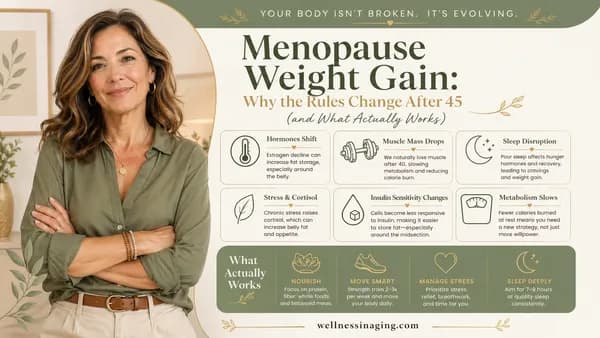
Menopause Weight Gain: Why the Rules Change After 45 (and What Actually Works)
Why menopause causes belly fat even when weight stays stable — the hormonal mechanism behind visceral fat redistribution and evidence-based strategies that work differently after 45.
Read article →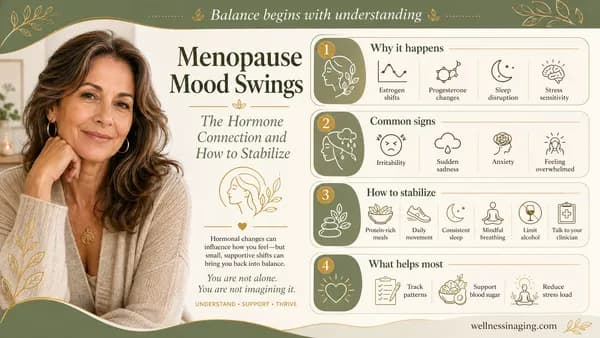
Menopause Mood Swings: The Hormone Connection and How to Stabilize
Why estrogen fluctuations cause dramatic mood changes during menopause — and evidence-based approaches from lifestyle to supplements to therapy.
Read article →
Joint Pain During Menopause: The Estrogen Connection and Natural Relief
Why declining estrogen causes joint pain during menopause — and which supplements, exercises, and lifestyle changes have clinical evidence behind them.
Read article →