
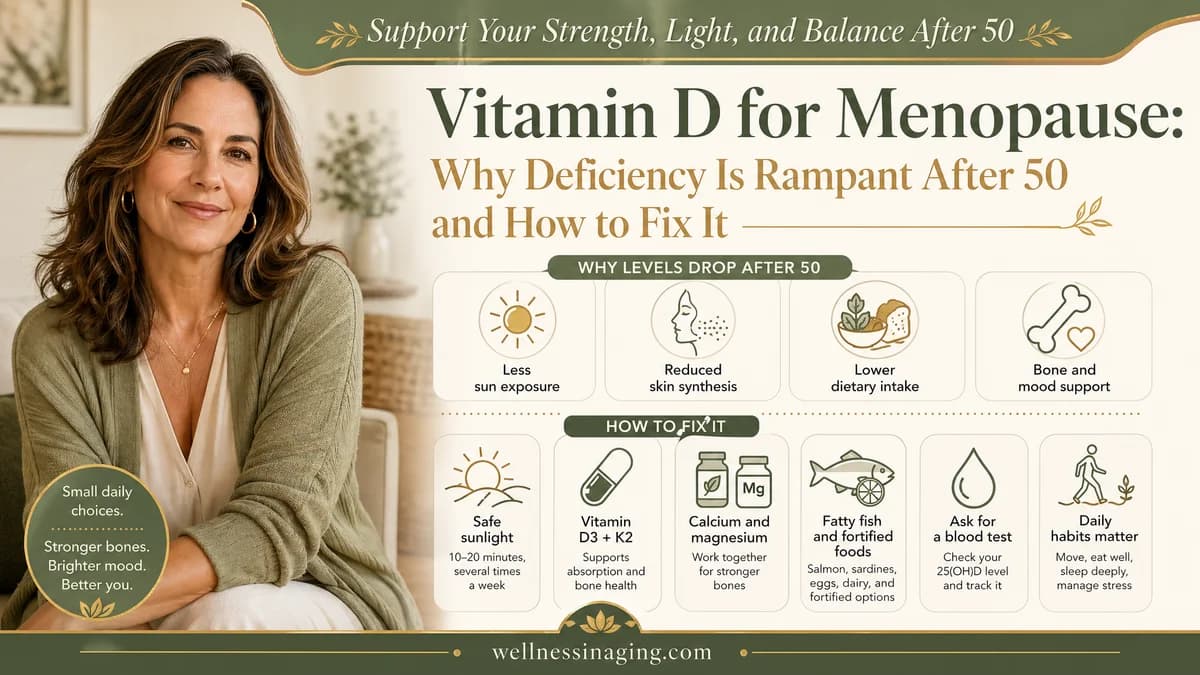
Up to 42% of American adults are vitamin D deficient — and postmenopausal women are overrepresented in that number by a significant margin. The reasons are specific and worth understanding, because "just get more sun" is not a practical or adequate solution after age 50.
Vitamin D deficiency in menopause isn't just a number on a lab report. Low vitamin D is associated with accelerated bone loss, increased fracture risk, lower mood, immune dysfunction, and worsening of several symptoms women are already struggling with during the menopause transition. It's also one of the most correctable nutritional deficiencies — inexpensive supplements work well, if you're taking the right form at the right dose.
Here's what's interesting about vitamin D deficiency: you don't feel deficient. There's no "low vitamin D headache" or telltale symptom that sends you to get tested. Most women discover they're deficient only when routine bloodwork happens to include a 25(OH)D test — or when bone density starts declining faster than expected.
This guide covers what vitamin D actually does in the menopausal body, why deficiency is so common after 50, how to know if you're deficient, and — critically — why the standard threshold for "sufficient" is set too low for most postmenopausal women.
Is This Article For You?
This guide is written for postmenopausal women who want to understand vitamin D's role in bone health, mood, and immune function — and why the D3+K2 combination matters more than most doctors explain. You'll learn the difference between "normal" and optimal vitamin D levels, how to choose the right supplement form, and what dosage actually works based on clinical trials.
Download the Menopause Starter Guide →
Why Deficiency Is So Common After 50
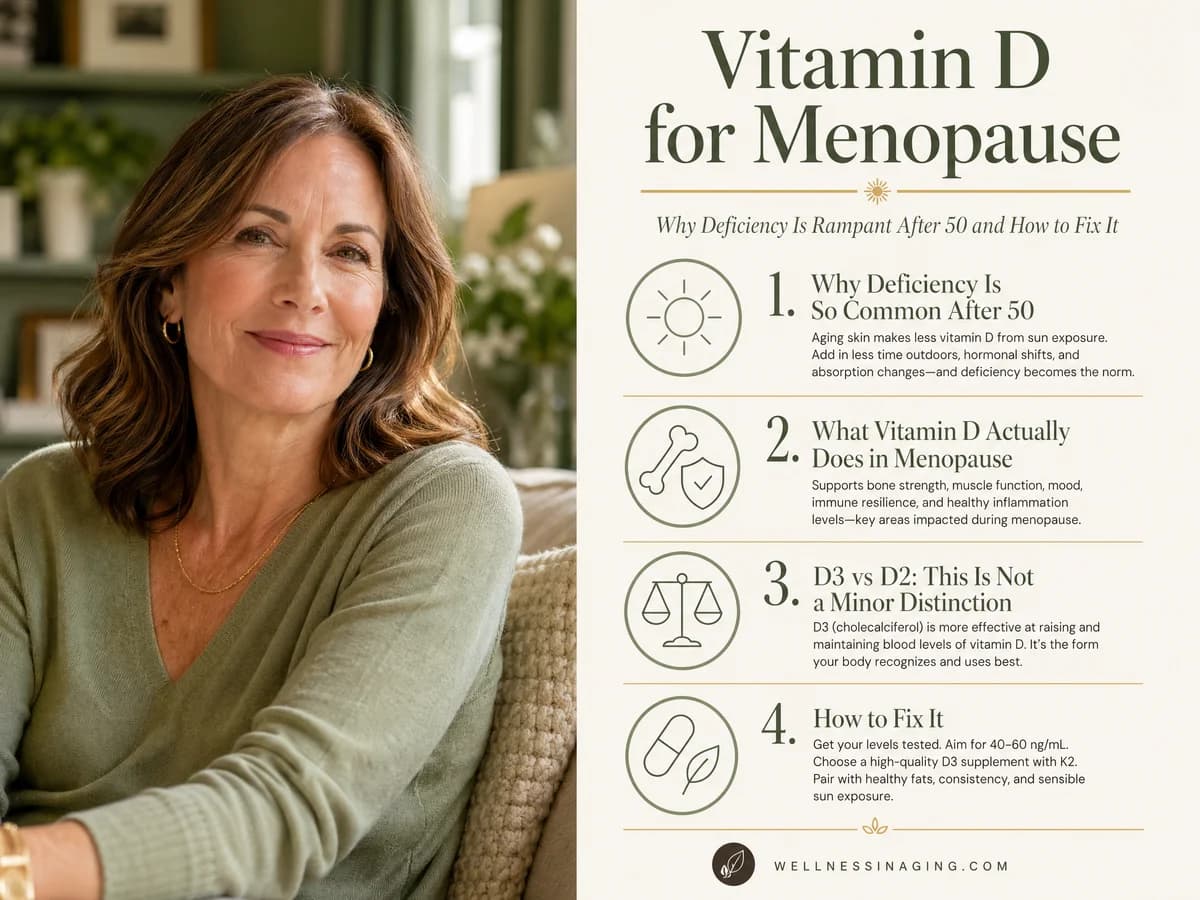
Six factors compound in postmenopausal women:
1. Age-related decline in skin synthesis. Your skin converts sunlight into vitamin D3 via a UV-B–driven reaction involving 7-dehydrocholesterol. This capacity declines by 50–75% between age 20 and 70. The same amount of sun exposure that would produce adequate vitamin D in a 25-year-old produces a fraction of that in a 65-year-old.
2. Reduced outdoor activity. Many women over 50 spend less time outdoors due to work patterns, mobility changes, and skin cancer concerns (which are legitimate — but the result is less UV exposure).
3. Geographic and seasonal limits. If you live above roughly 37°N latitude (approximately San Francisco, Denver, Richmond VA), your skin produces virtually no vitamin D from sunlight between October and April — regardless of how much time you spend outdoors. This covers most of the continental United States for half the year.
4. Estrogen's effect on vitamin D metabolism. Estrogen appears to support the activation of vitamin D in the body. As estrogen declines during menopause, vitamin D metabolism may become less efficient — meaning the same blood levels may have reduced effect.
5. Adipose tissue sequestration. Vitamin D is fat-soluble, which means it accumulates in adipose (fat) tissue. As body composition shifts during menopause — with many women gaining visceral and subcutaneous fat — more circulating vitamin D gets trapped in fat stores and becomes less bioavailable.
6. Declining kidney function. The kidneys handle the final activation step of vitamin D (converting 25-OH vitamin D to the active 1,25-OH form). Kidney function declines gradually with age, reducing conversion efficiency.
The cumulative effect is predictable: postmenopausal women have systematically lower vitamin D levels than younger women consuming the same dietary intake and getting the same sun exposure.
What Vitamin D Actually Does in Menopause
Evidence rating key: Strong / Moderate / Weak / Insufficient
Bone health and fracture prevention — Strong
This is the most evidence-supported benefit and the one most directly relevant to postmenopausal women. Estrogen loss accelerates bone resorption dramatically — women can lose 2–3% of bone density per year in the first 5–7 years after menopause. Vitamin D is essential here in two ways:
First, vitamin D is required for calcium absorption from the gut. Without adequate vitamin D, only 10–15% of dietary calcium is absorbed; with adequate vitamin D, absorption rises to 30–40%.
Second, vitamin D directly regulates osteoblast (bone-building) and osteoclast (bone-resorbing) activity.
Key trial: Chapuy et al. (1992) in NEJM — a landmark study of 3,270 elderly women given 800 IU vitamin D3 plus 1,200mg calcium daily. After 18 months: 43% reduction in hip fractures, 32% reduction in non-vertebral fractures.
Key meta-analysis: Bischoff-Ferrari et al. (2012) — pooled analysis finding that fracture risk reduction was significant only at doses of 800 IU or more per day. Lower doses showed no meaningful fracture benefit.
Most standard multivitamins contain 400 IU, which the evidence suggests is insufficient for fracture prevention.
What this means: Vitamin D supplementation for bone health in postmenopausal women should target at least 800–1,000 IU daily at minimum, with most experts now recommending 1,500–2,000 IU for optimal effect.
Mood and depression — Moderate
Vitamin D receptors are present throughout the brain, including in regions regulating mood (limbic system, prefrontal cortex). Low vitamin D is consistently associated with higher rates of depression in cross-sectional studies.
A 2011 study by Bertone-Johnson et al. found that women with the highest vitamin D intake had approximately 20% lower risk of depression compared to those with the lowest intake. The association was strongest in women with pre-existing low levels — suggesting that supplementation helps most in those who are genuinely deficient rather than those already replete.
When estrogen fluctuations already increase depression risk during perimenopause and early menopause, maintaining adequate vitamin D is a reasonable and low-risk supporting strategy.
Hot flashes — Weak / Insufficient
Vitamin D is frequently recommended for hot flashes, but the clinical evidence is thin. No large, well-designed RCT has demonstrated meaningful hot flash reduction from vitamin D supplementation in postmenopausal women. Some small observational studies show associations between low vitamin D and more frequent hot flashes, but association is not causation.
Set realistic expectations: take vitamin D for bone health and mood support. Don't take it expecting hot flash relief — and don't stop a more effective intervention if hot flashes are your primary problem.
Immune function — Moderate
Vitamin D is well-established as a modulator of immune function, particularly innate immunity. Low vitamin D is associated with increased susceptibility to upper respiratory infections and autoimmune conditions. Women in the menopausal transition — who face hormonal shifts that affect immune regulation — have reasonable motivation to maintain adequate vitamin D for general immune health.
Cardiovascular health — Weak
Early observational studies suggested vitamin D deficiency was associated with higher cardiovascular risk. The large VITAL trial (Manson et al., NEJM 2019) — an RCT of 25,871 adults taking 2,000 IU vitamin D3 daily for 5 years — found no significant reduction in major cardiovascular events. The cardiovascular case for supplementation has weakened considerably in recent years.
D3 vs D2: This Is Not a Minor Distinction
Vitamin D comes in two supplemental forms:
- Vitamin D3 (cholecalciferol): Derived from lanolin (sheep wool) or lichen (vegan). This is the form your skin produces from sunlight.
- Vitamin D2 (ergocalciferol): Derived from UV-irradiated fungi. This is the form used in most prescription vitamin D supplements in the US.
The clinical evidence strongly favors D3. A meta-analysis by Tripkovic et al. (2012) found D3 was 87% more effective than D2 at raising and maintaining blood 25(OH)D levels. A 2006 analysis by Houghton and Vieth confirmed D3's superior potency and longer half-life in circulation.
When choosing a supplement, always verify you are buying D3 (cholecalciferol), not D2 (ergocalciferol). If you've been prescribed 50,000 IU weekly by your doctor for deficiency correction, it's likely D2 — ask about D3 alternatives.
The Case for Combining D3 with K2
Vitamin K2 (menaquinone, particularly the MK-7 form) works in essential partnership with vitamin D for bone health — and this combination addresses a cardiovascular concern that doesn't get enough attention.
The D3+K2 combination is one of those supplement pairings that sounds like marketing hype until you actually read the mechanism studies. Then it becomes clear why taking D3 alone is leaving something important on the table.
How it works: Vitamin D increases calcium absorption from the gut. Vitamin K2 activates osteocalcin (which binds calcium into bone) and matrix Gla protein (which prevents calcium from depositing in arteries and soft tissue).
Without adequate K2, supplemental vitamin D + calcium can paradoxically increase arterial calcification — calcium gets absorbed but doesn't end up where you want it.
Key evidence:
- Knapen et al. (2013) — 3-year RCT in postmenopausal women: K2 supplementation (MK-7, 180 mcg/day) significantly improved femoral neck and lumbar spine bone density compared to placebo.
- Geleijnse et al. (2004, Rotterdam Study) — high dietary K2 intake associated with 50% reduction in aortic calcification and 57% lower risk of dying from heart disease.
Choose a D3+K2 combination supplement rather than D3 alone. Look for:
- D3 (cholecalciferol): 2,000–4,000 IU
- K2 as MK-7 (menaquinone-7): 100–200 mcg
The MK-7 form of K2 is preferred over MK-4 due to its longer half-life in circulation (72 hours vs 1–2 hours) and better clinical trial evidence.
How to Know If You're Deficient: Testing
The relevant blood test is 25-hydroxyvitamin D (25(OH)D), also written as 25-OH vitamin D or calcidiol. This measures your vitamin D status in blood.
What the numbers mean:
| Level | Classification | What It Means |
|---|---|---|
| Below 12 ng/mL | Severely deficient | Bone health compromised; supplementation urgent |
| 12–20 ng/mL | Deficient | Below the clinical threshold; supplementation needed |
| 20–29 ng/mL | Insufficient | "Normal" per some guidelines, but likely suboptimal |
| 30–39 ng/mL | Adequate (conservative) | Meets basic requirements |
| 40–60 ng/mL | Optimal | Level most functional medicine and integrative physicians target |
| Above 100 ng/mL | Potentially toxic | Risk of hypercalcemia |
The standard vs optimal debate: The US Institute of Medicine set the "sufficient" threshold at 20 ng/mL. Many endocrinologists, bone health specialists, and the Endocrine Society argue that 30–40 ng/mL is a more appropriate minimum, with 40–60 ng/mL as optimal for postmenopausal women specifically.
Most women who come back with a lab result of 22 ng/mL are told they're "fine" — but they're likely not optimal.
How to get tested:
- Request 25(OH)D from your primary care doctor (often covered by insurance)
- At-home options: Everlywell Vitamin D Test (
$49), LetsGetChecked ($59) - Retest 3 months after starting supplementation to verify your levels are responding
Dosing: What's Safe and What's Effective
| Situation | Recommended Dose | Notes |
|---|---|---|
| Maintenance (level 40–60 ng/mL) | 1,000–2,000 IU D3 daily | Take with a fat-containing meal for best absorption |
| Insufficient (20–39 ng/mL) | 2,000–4,000 IU D3 daily | Retest in 3 months |
| Deficient (below 20 ng/mL) | 4,000–5,000 IU D3 daily | Consider high-dose short course under medical supervision |
| Severe deficiency | 50,000 IU weekly × 8 weeks | Physician-supervised; usually prescribed as D2 |
The rule of thumb: Every 100 IU of vitamin D3 daily raises 25(OH)D by approximately 1 ng/mL over 3 months. If your level is 25 ng/mL and you want to reach 50 ng/mL, you'd need approximately 2,500 IU additional daily for 3 months. Individual response varies.
Upper safe limit: The tolerable upper intake level (UL) is 4,000 IU/day per the Institute of Medicine, though many experts consider 10,000 IU/day safe in the absence of hypercalcemia. Toxicity (causing dangerously high blood calcium) is rare and typically requires chronic doses above 10,000 IU/day for months.
Timing: Vitamin D is fat-soluble. Take it with your largest meal of the day (the one containing the most fat) for maximum absorption.
Drug Interactions
Vitamin D has several important interactions to be aware of:
- Corticosteroids (prednisone, dexamethasone): Reduce vitamin D absorption and increase urinary calcium loss — people on long-term corticosteroids typically need higher vitamin D doses
- Cholestyramine (Questran) and orlistat (Alli, Xenical): Reduce fat absorption, which reduces absorption of fat-soluble vitamins including D3
- Antiepileptic drugs (phenytoin, phenobarbital): Accelerate vitamin D breakdown; may need higher supplementation
- Thiazide diuretics: Combined with vitamin D supplementation, may increase risk of hypercalcemia — monitor calcium levels
- Digoxin: Hypercalcemia (from excess vitamin D) can increase digoxin toxicity
Tell your prescribing doctor if you're starting or increasing vitamin D supplementation, particularly if you're on any of the above medications.
What to Look For in a Supplement
Minimum requirements:
- Vitamin D3 (cholecalciferol) — not D2
- Clearly stated IU dose on label
- Third-party tested (USP, NSF, or Informed Sport certification)
Better:
- D3+K2 combination (K2 as MK-7 specifically)
- Softgel or liquid form (better absorption than tablets for fat-soluble vitamins)
- No unnecessary fillers or artificial ingredients
Products worth considering:
- Thorne D3+K2 — pharmaceutical-grade, NSF Certified, liquid dropper format for flexible dosing. Premium price.
- Sports Research D3+K2 — well-studied D3 (5,000 IU) + MK-7 K2 (100 mcg) in organic olive oil softgel. Good value.
- Pure Encapsulations D3 — physician-trusted brand, hypoallergenic formulation, available in multiple IU levels
- NOW Foods D3 — budget-friendly, reliable, third-party tested; doesn't include K2 so pair with a separate K2 supplement
- Garden of Life mykind Organics D3 — vegan, lichen-derived D3, for those avoiding animal-derived supplements
Want to know your current vitamin D level before starting? Everlywell's at-home vitamin D test gives you results in days without a doctor visit — helpful for determining your starting dose.
Is Vitamin D Supplementation Right for You?
This article is for you if:
- You're a postmenopausal woman (the case for routine vitamin D supplementation is strong for nearly all women over 50)
- You've been diagnosed with osteopenia or osteoporosis and want to protect bone density
- You live in a northern climate or rarely spend time outdoors
- You want to understand the D3 vs D2 question and why the D3+K2 combination matters
- You've been told your vitamin D level is "normal" at 22 ng/mL and want to know if that's actually optimal
Pay particular attention to vitamin D if you:
- Have been on corticosteroids for more than a few weeks
- Experience mood changes or low energy during winter months
- Have a history of fractures from low-impact events
- Are taking medications that interfere with vitamin D absorption or metabolism
This won't fix (set realistic expectations):
- Hot flashes (insufficient evidence for symptom relief)
- Vaginal dryness
- Brain fog (unless you're significantly deficient)
- Sleep problems
Take Action
Know your level: Download our free Menopause Starter Guide to track your vitamin D test results and calculate your target dose based on current levels.
Start supplementing: For most postmenopausal women, a D3+K2 combination at 2,000 IU D3 + 100 mcg K2 (MK-7) is a reasonable starting point. Top evidence-based options:
- Thorne D3+K2 — pharmaceutical-grade liquid
- Sports Research D3+K2 — best value softgel
Test at home: Everlywell Vitamin D Test — no doctor visit required; retest in 3 months to verify your dose is working.
Download the Menopause Starter Guide →
Want evidence-based menopause strategies in your inbox? Our weekly newsletter covers the latest research on supplements, natural remedies, and nutrition strategies — no fluff, just practical guidance you can use.
This content is for informational purposes only and does not constitute medical advice. Always consult with a qualified healthcare provider before starting any new supplement or treatment. Individual results may vary.
Related Reading
- Magnesium for Menopause — works synergistically with vitamin D for bone health (magnesium is required to activate vitamin D)
- Best Menopause Supplements 2026 — where D3+K2 fits in the broader supplement picture
- Black Cohosh for Menopause — another evidence-based supplement option for symptom management
- Magnesium Glycinate vs Citrate for Menopause — choosing the right magnesium form to pair with vitamin D
- Joint Pain During Menopause — how vitamin D and bone health connect to joint health
- Anti-Inflammatory Diet for Menopause — dietary strategies that support vitamin D absorption and overall wellness
References
- Chapuy MC, et al. (1992). "Vitamin D3 and calcium to prevent hip fractures in elderly women." New England Journal of Medicine, 327(23): 1637–1642.
- Bischoff-Ferrari HA, et al. (2012). "A pooled analysis of vitamin D dose requirements for fracture prevention." New England Journal of Medicine, 367(1): 40–49.
- Tripkovic L, et al. (2012). "Comparison of vitamin D2 and vitamin D3 supplementation in raising serum 25-hydroxyvitamin D status." American Journal of Clinical Nutrition, 95(6): 1357–1364.
- Houghton LA, Vieth R. (2006). "The case against ergocalciferol (vitamin D2) as a vitamin supplement." American Journal of Clinical Nutrition, 84(4): 694–697.
- Knapen MH, et al. (2013). "Three-year low-dose menaquinone-7 supplementation helps decrease bone loss in postmenopausal women." Osteoporosis International, 24(9): 2499–2507.
- Geleijnse JM, et al. (2004). "Dietary intake of menaquinone is associated with a reduced risk of coronary heart disease." Journal of Nutrition, 134(11): 3100–3105.
- Bertone-Johnson ER, et al. (2011). "Vitamin D intake from foods and supplements and depressive symptoms in a diverse population of older women." American Journal of Clinical Nutrition, 94(4): 1104–1112.
- Manson JE, et al. (2019). "Vitamin D supplements and prevention of cancer and cardiovascular disease." New England Journal of Medicine, 380(1): 33–44.
- Holick MF. (2007). "Vitamin D deficiency." New England Journal of Medicine, 357(3): 266–281.
- Endocrine Society. (2011). "Evaluation, treatment, and prevention of vitamin D deficiency: an Endocrine Society clinical practice guideline." Journal of Clinical Endocrinology & Metabolism, 96(7): 1911–1930.
Free Download
The Menopause Supplement Evidence Guide
Which supplements have real research behind them. 12 pages, free.
Related Articles
Probiotics and Menopause: The Gut-Hormone Connection (What the Science Says)
Your gut bacteria directly regulate estrogen metabolism through the estrobolome. Here's what probiotics can and can't do for menopause — with strain-specific evidence for bone health, mood, and vaginal health.
Read article →
Omega-3 for Menopause: What It Helps With (and What It Doesn't)
Omega-3s have strong evidence for mood, joint pain, and heart health during menopause — but NOT for hot flashes. Here's the RCT data, the correct EPA vs DHA dose by symptom, and how to avoid rancid fish oil.
Read article →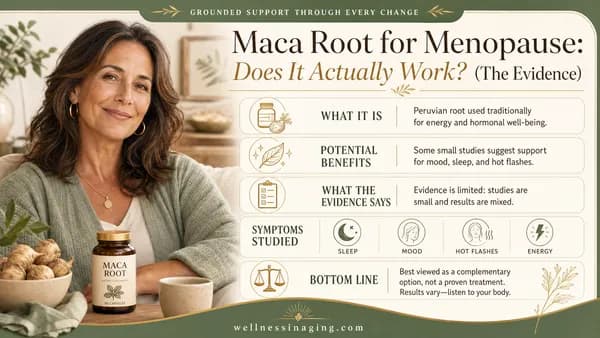
Maca Root for Menopause: Does It Actually Work? (The Evidence)
Maca root is widely promoted for menopause. Here's what the RCTs actually show — what it helps with (libido, mood), what it doesn't (hot flashes), and the correct dose.
Read article →